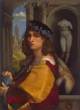
Italian painter. He moved from Venice to Treviso c. 1517, where he is well documented (though there is little about his painting). In 1518-19 he married Camilla, daughter of the painter PierGLOSSARYOne of the massive supports on which an arch or upper part of a church stands. A pier is generally larger than a column, but may consist of a cluster of columns. Maria Pennacchi. A coherent body of work executed between 1518 and 1528 has been reconstructed.
Capriolo's first secure work, the Adoration of the Shepherds (Treviso, Museo Civico), signed and dated 1518, has a formal structure reminiscent of the late style of Giovanni Bellini, with the broader chromatic range of Palma Vecchio and a crepuscular light that recalls the Venetian works of Giovanni Girolamo Savoldo or Giovanni da Asola (active 1512-31). The Assumption in Treviso CathedralGLOSSARYThe principal church of a province or diocese, where the throne of the bishop is placed. For reasons lost to time and tradition, a cathedral always faces west - toward the setting sun. The altar is placed at the east end. The main body, or nave, of the cathedral is usually divided into one main and two side aisles. These lead up to the north and south transepts, or arms of the cross, the shape in which a cathedral is usually formed., commissioned in 1520, shows, in its spiralling movement, the influence of the contemporary frescoes of Pordenone in the nearby Malchiostro ChapelGLOSSARYa small separate place for worship, either part of a large church or a separate building.. In the Legend of the Doubting Midwife (Treviso, Museo Civico), signed and dated 1524, the influence of Savoldo is greater than that of Palma. This is also apparent in the altarpieceGLOSSARYA picture or sculpture that stands on or is set up behind an altar. The term reredos is used for an ornamental screen or partition, not directly attached to the altar table but affixed to the wall behind it. A diptych is an altarpiece consisting of two panels, a triptych one of three panels, and a polyptych one of four or more panels. From the 14th to 16th century, the altarpiece was one of the most important commissions in European art; it was through the altarpiece that some of the most decisive developments in painting and sculpture came about. of the parish church of Ponzano Veneto (Treviso), dated 1525. The portraitGLOSSARYThe Roman portrait bust survived in the form of life-sized reliquaries of saints, but it was in 15th century Florence that the individual features and character of a contemporary sitter were accurately recorded by sculptors such as Donatello, Desiderio da Settignano, Mino da Fiesole and the Rossellino. A similar degree of realism occurs in 15th century tomb sculpture. The equestrian portrait, based on antique statues such as the Marcus Aurelius monument (Rome, Campidoglio), was revived in the 14th century. Two examples in fresco are Simone Martini's Guidoriccio (c. 1328; Siena, Palazzo Pubblico) and the posthumous portrait of Sir John Hawkwood (1436; Florence, Cathedral) by Uccello, which gives the illusion of a 3-dimensional statue seen from below. The Venetian Republic ordered imposing monuments from Donatello (1447; Gattarnelata, Padua) and Verrocchio (14799; Colleoni, Venice), whilst other statesmen ordered their own images to be erected in public places, directly relating themselves to the military heroes of ancient Rome. Another form of political portraiture derived from antiquity was the commemorative portrait medal designed by artists such as Pisanello. The carved or painted profile portrait became popular in the 1450s. The realism of the clear, flattened image, painted under the influence of Flemish examples by the Pollaiuolo brothers, Piero della Francesca and Botticelli, was superseded by the three-quarter and frontal portrait, psychologically more complex, such as Leonardo's enigmatic Mona Lisa (Paris, Louvre) with her momentary smile or Andrea del Sarto's arresting Portrait of a Man (London, National Gallery). The 16th century portrait became generalized, Lotto's Andrea Odoni (1527; Royal Collection) being an idealized concept of a collector rather than an individual. Group portraits, decorating whole rooms, include the narrative scenes of the Gonzaga court painted by Mantegna (completed 1474; Mantua, Palazzo Ducale) and the elaborate schemes commissioned by the Farnese family in Rome from Vasari (1546; Palazzo della Cancelleria) and Salviati (after 1553; Palazzo Farnese). Portraits were also incorporated into religious narratives, as in Ghirlandaio's fresco cycle painted for Giovanni Tornabuoni in S. Maria Novella, Florence (1486-90). of Lelio Torelli (Barnard Castle, Bowes Museum), signed and dated 1528, Capriolo's last known work, seems by contrast to reflect local models of portraiture and lies somewhere between the styles of Sebastiano Florigerio and Bernardino Licinio.
Other works assigned to Capriolo include: the altarpieces of the parish churches of Cavasagra and Spercenigo, near Treviso; the Adoration of the Shepherds in the sacristyGLOSSARYa side room of a church where a priest puts on his vestments and where the sacred vessels and vestments are kept. of Serravalle Cathedral at Vittorio Veneto; a fragment of a Nativity (Venice, Museo Correr); two paintings of the Virgin and Child with Saints (Bucharest, Museum of Art; Conegliano, Museo Civico del CastelloGLOSSARY"castle", palace.); and the Portrait of a Musician (Vienna, Kunsthistorisches Museum), previously attributed to Pordenone. Capriolo was murdered by his wife's stepfather, after years of litigation about her dowry.