03 — ARTWORK
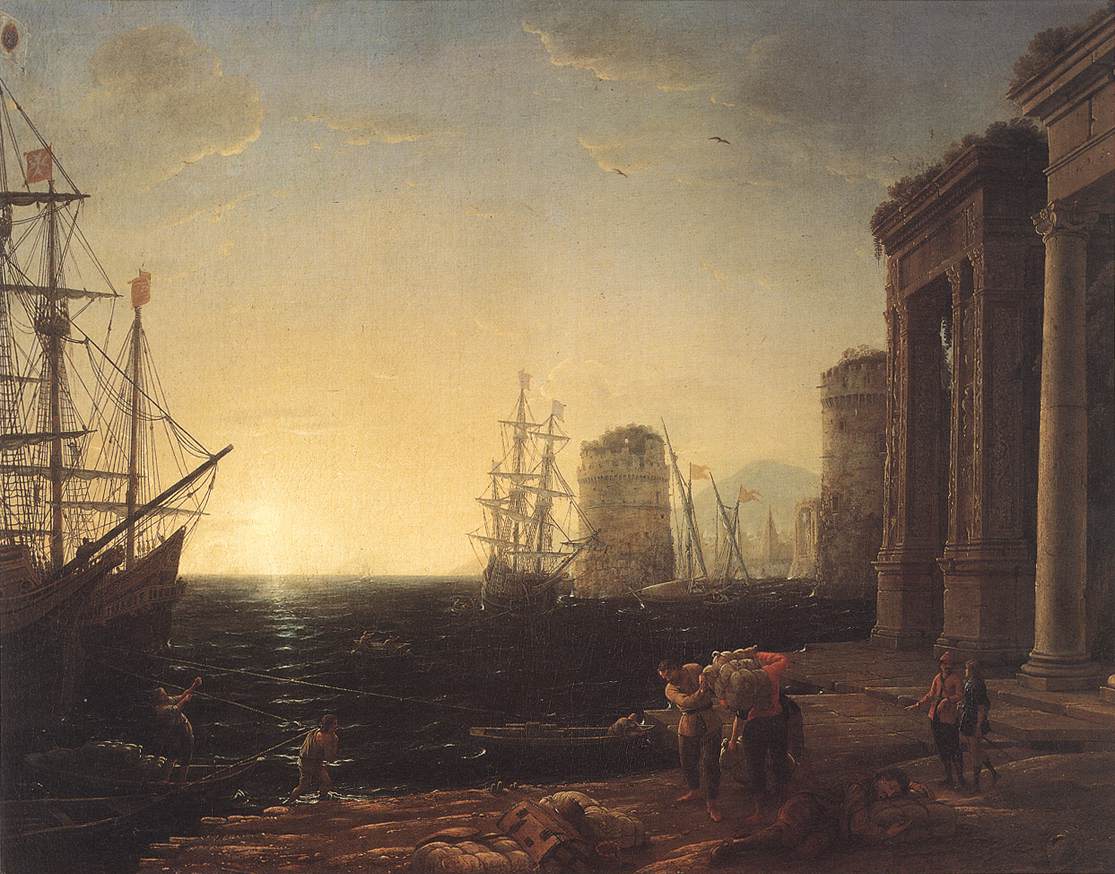
Harbour Scene at Sunset
- MEDIUM
- Oil on canvas, 74 x 99 cm
- TYPE
- Landscape
PALETTE
HOVER OR TAP A SWATCH FOR NAME, SHARE AND HEX. SAMPLED FROM THE IMAGE — INDICATIVE, NOT A PIGMENT ANALYSIS.
DEVELOPMENT BUILD — NOT FOR PUBLIC USE. CONTRIBUTE ON GITHUB.
03 — ARTWORK
PALETTE
HOVER OR TAP A SWATCH FOR NAME, SHARE AND HEX. SAMPLED FROM THE IMAGE — INDICATIVE, NOT A PIGMENT ANALYSIS.
COMMENTARY
UNDERLINED TERMS ARE DEFINED IN THE GLOSSARY.
The composition is in some respects related to a drawing (LV 19) in Claude's Liber Veritatis, a drawn record kept by the artist himself of his finished paintings. The picture which LV 19 actually records is dated 1637 (Private collection, England). Although the present painting of 1643 is best described as an autograph replica of the earlier work, there are considerable differences between the two compositions. The round tower on the left of the earlier composition has been moved to the right, closer to the buildings seen on the shore, where it has been paired with another tower of similar design. The left edge of the later composition is dominated by two ships, balanced at the right edge by two porticoes instead of one. The man lying asleep in the foreground, who does not occur in LV 19 but is introduced into the painting of 1637, is retained in the present painting although the pose is reversed.
The connections - albeit inexact - between this Harbour Scene and LV 19 have resulted in the painting being dated to 1637, but cleaning in 1969 confirmed the authenticity of the date of 1643. Once this was established the stylistic distinctions evident between works of the 1630s and the 1640s could be confirmed. The deep ultramarine tone of the water, the overall warmth of colour, and the more solid drawing of the figures, which, as a result, have a greater feeling of corporeality, are characteristic of the later decade. Comparison with the seaport scenes in the collections of the Duke of Northumberland and the Marquess of Bute, dating from 1637 and 1638 respectively, or with the rendering in Florence (Uffizi), also of 1638, reinforces these stylistic shifts. The picture in the Royal Collection was painted in the same year as Coast View with Mercury and Aglauros (Rome, Pallavicini collection) and Coast View with the Trojan Women setting Fire to their Fleet (New York, Metropolitan Museum). Three similar harbour scenes in the National Galleryan upper story, similar to a tribune, running along the side of a building and open on one side to the interior; in a church (basilica) above the side aisles, over the ambulatory (central-plan building) and also over the west end. The gallery was used to keep certain groups of worshippers apart (women, noblemen)., London, date from the 1640s and are comparable in style: Seaport with the Embarkation of Saint Ursula, Seaport of 1644, and Seaport with the Embarkation of the Queen of Sheba of 1648 - this last an inspiration to J. M. W. Turner.
Harbour scenes occur frequently throughout Claude's oeuvreThe complete body of works created by an artist.. Usually depicted at sunset and populated by a full cast of staffageThis word, pronounced as French, is used in both English and German to describe the figures and animals which animate a picture intended essentially as a landscape or veduta; in other words, figures which are not really essential and could be added by another painter. In the highly specialized world of the Dutch painters of the 17th century this was very often the case, so that a landscape painter like Wynants rarely did his own staffage; whereas Canaletto or Guardi always did. figures, busying themselves by loading and unloading ships or simply idling the day away in conversation, these compositions and the mood they created found favour with British collectors and were emulated by British artists. The only firmly identifiable building in the present picture is the monumental gateway on the right next to the round tower. This is based on the Arcus Argentarium (ArchThe pointed arch is widely regarded as the main identifiable feature of Gothic architecture (distinct from the round arch of the Romanesque period). The three most common Gothic arches are the Equilateral, Lancet and Tudor. of the Silversmiths), dating from the third century AD at San Giorgio in Velabro, Rome, although it is seen in reverse and detached from the church. A view of this arch and the church occurs in an early drawing by Claude at Windsor Castle.
@online{wga-r1bcd1b206338ca,
  author       = {Krén, Emil and Marx, Daniel},
  title        = {Harbour Scene at Sunset by CLAUDE LORRAIN},
  organization = {{Web Gallery of Art}},
  date         = {2026-09-13},
  url          = {https://beta.wga.hu/artists/claude-lorrain-rfda65e38588258/harbour-scene-at-sunset-r1bcd1b206338ca},
  urldate      = {2026-09-13},
  langid       = {english}
}
ACCESSED 2026-09-13. REPLACE THE AUTHOR FIELD WITH THE COMMENTARY AUTHOR WHERE ONE IS NAMED.


