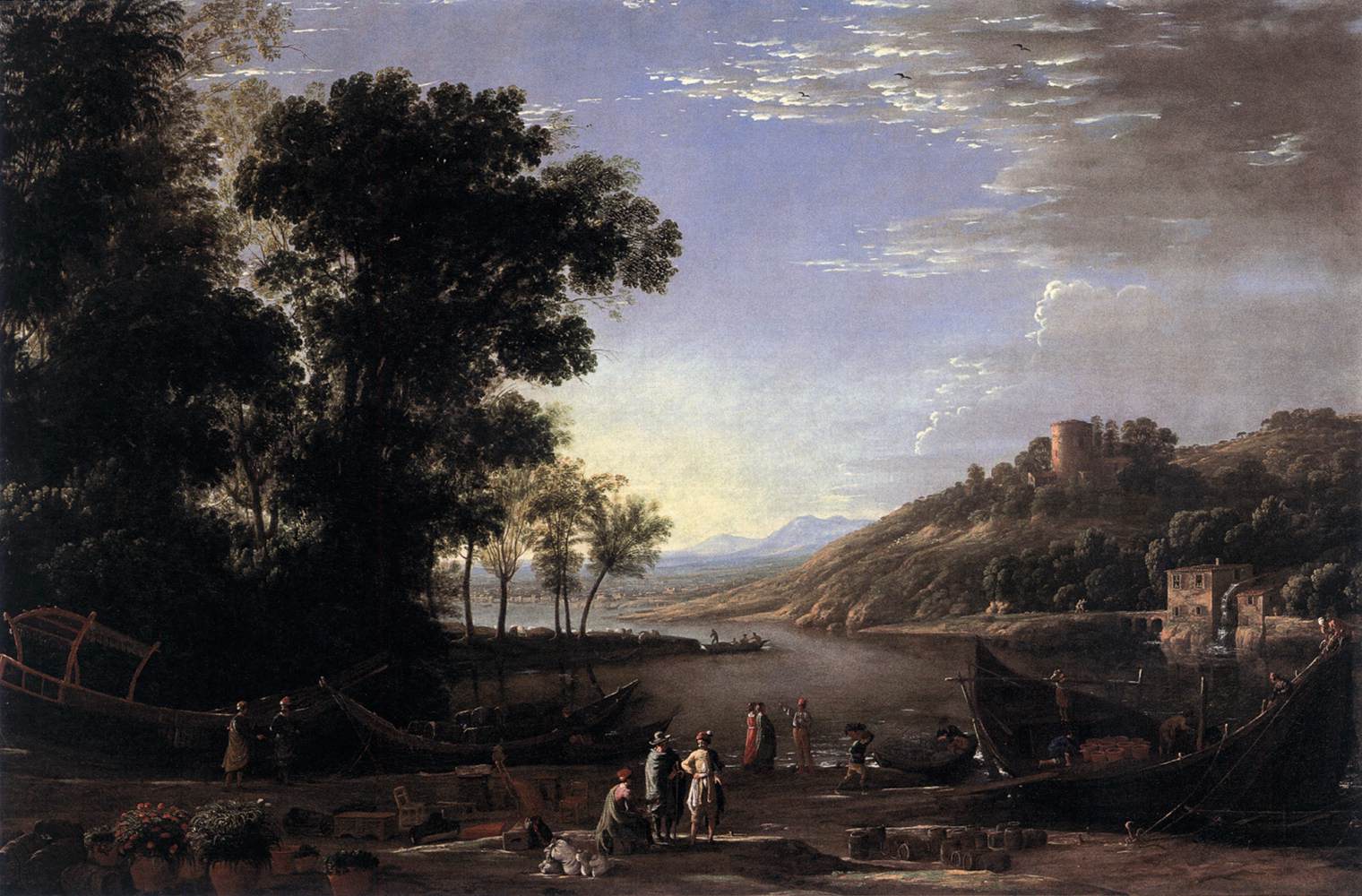
03 — ARTWORK
Landscape with Merchants
- MEDIUM
- Oil on canvas, 97 x 144 cm
- TYPE
- Landscape
PALETTE
HOVER OR TAP A SWATCH FOR NAME, SHARE AND HEX. SAMPLED FROM THE IMAGE — INDICATIVE, NOT A PIGMENT ANALYSIS.
DEVELOPMENT BUILD — NOT FOR PUBLIC USE. CONTRIBUTE ON GITHUB.
03 — ARTWORK
PALETTE
HOVER OR TAP A SWATCH FOR NAME, SHARE AND HEX. SAMPLED FROM THE IMAGE — INDICATIVE, NOT A PIGMENT ANALYSIS.
COMMENTARY
UNDERLINED TERMS ARE DEFINED IN THE GLOSSARY.
Landscape with Merchants c. 1630 Oil on canvasA woven cloth used as a support for painting. The best-quality canvas is made of linen; other materials used are cotton, hemp, and jute. It is now so familiar a material that the word 'canvas' has become almost a synonym for an oil painting, but it was not until around 1500 that it began to rival the wooden panel (which was more expensive and took longer to prepare) as the standard support for movable paintings (the transition came later in Northern Europe than in Italy). Canvas is not suitable for painting on until it has been coated with a ground, which isolates the fabric from the paint; otherwise it will absorb too much paint, only very rough effects will be obtainable, and parts of the fabric may be rotted by the pigments. It must also be made taut on a stretcher or by some other means., 97 x 144 cm National Galleryan upper story, similar to a tribune, running along the side of a building and open on one side to the interior; in a church (basilica) above the side aisles, over the ambulatory (central-plan building) and also over the west end. The gallery was used to keep certain groups of worshippers apart (women, noblemen). of Art, Washington
This is an early work of the artist, probably from about 1630 before he began the Liber Veritatis.
Claude's earliest surviving pictures have usually been dated to around 1630, although he did not begin to keeptall, strong tower in medieval castles, used as an observation post and last refuge for those living in the castle, an, unlike the donjon, not designed for permanent habitation. accurate records until the mid-1630s. By this time he was already mature, and so it is from the evidence supplied by the undated pictures that his first hesitant steps have to be reconstructed. The fact that he developed so rapidly from his first unpromising topographical scenes to become the virtual inventor of the atmospheric and poetical landscape is evidence of his geniusin classical Rome, a person's invisible tutelary god. In art from the classical period onwards, the low-ranking god was depicted as a winged, usually childish figure.. In the early pictures, considerable reference is made to a wide variety of painters, all of them landscapists. By about 1630 an enormous amount of landscape painting was going on in Rome, soon to be increased by the innovations of Poussin and Dughet. Claude therefore had to contend with many other artists working in mature styles, either influencing or ignoring one another. He drew almost casually from this varied background, now leaning on one, now on another, and then discarding them all, to achieve total self-confidence by the time he was thirty-five.
@online{wga-rdd733ce2b90c91,
  author       = {Krén, Emil and Marx, Daniel},
  title        = {Landscape with Merchants by CLAUDE LORRAIN},
  organization = {{Web Gallery of Art}},
  date         = {2026-09-13},
  url          = {https://beta.wga.hu/artists/claude-lorrain-rfda65e38588258/landscape-with-merchants-rdd733ce2b90c91},
  urldate      = {2026-09-13},
  langid       = {english}
}
ACCESSED 2026-09-13. REPLACE THE AUTHOR FIELD WITH THE COMMENTARY AUTHOR WHERE ONE IS NAMED.


