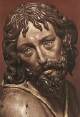
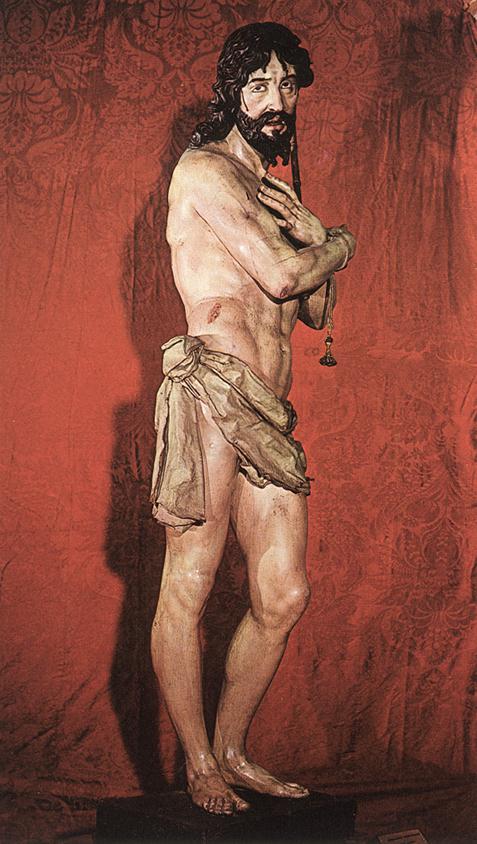
Gregório Fernandez (or Hernandez), Spanish sculptor, active at Valladolid from c.1605. Continuing the tradition of painted religious sculpture, he worked in the manner of Juan de Juni but with greater realismGLOSSARYRealism (with an upper case "R"), also known as the Realist school, denotes a mid-nineteenth century art movement and style in which artists discarded the formulas of Neoclassicism and the theatrical drama of Romanticism to paint familiar scenes and events as they actually looked. Typically it involved some sort of sociopolitical or moral message, in the depiction of ugly or commonplace subjects. One of the main representatives and spokesmen was the painter Gustave Courbet. In the dispute about ways to represent reality, Realism rebelled against the idealistic and classicist tendencies in painting. of expressive gesture. He was one of the first and greatest masters of BaroqueGLOSSARYThe period in art history from about 1600 to about 1750. In this sense the term covers a wide range of styles and artists. In painting and sculpture there were three main forms of Baroque: (1) sumptuous display, a style associated with the Catholic Counter Reformation and the absolutist courts of Europe (Bernini, Rubens); (2) dramatic realism (Caravaggio); and (3) everyday realism, a development seen in particular in Holland (Rembrandt, Vermeer). In architecture, there was an emphasis on expressiveness and grandeur, achieved through scale, the dramatic use of light and shadow, and increasingly elaborate decoration. In a more limited sense the term Baroque often refers to the first of these categories. The development of the Baroque reflects the period's religious tensions (Catholic versus Protestant); a new and more expansive world view based on science and exploration; and the growth of absolutist monarchies. naturalismGLOSSARYGeneric term for scientific positions supported by natural insights. In fine arts and literature between approximately 1870 and 1900, Naturalism tried to reproduce the reality comprehended through sensory experience as realistically as possible, i.e. without idealising the object, but with scientific precision. In contrast to Realism, which was also based on the accurate description of natural occurrences, Naturalism concerns itself with the sensual dimensions of observation, whereby questions of morality and social criticism come to the fore. The spokesman for literary Naturalism was Emile Zola, who believed the artistic methods provided evidence of human existence. in Spain, abandoning the earlier practice of using gold and brilliant colours and insisting upon realistic colouring from the polychromists who painted his sculptures. Among the numerous altarpieces emanating from his workshop are those of S. Miguel, Valladolid (1606) and Plasencia CathedralGLOSSARYThe principal church of a province or diocese, where the throne of the bishop is placed. For reasons lost to time and tradition, a cathedral always faces west - toward the setting sun. The altar is placed at the east end. The main body, or nave, of the cathedral is usually divided into one main and two side aisles. These lead up to the north and south transepts, or arms of the cross, the shape in which a cathedral is usually formed. (1624-34). He is well represented in Valladolid Museum.