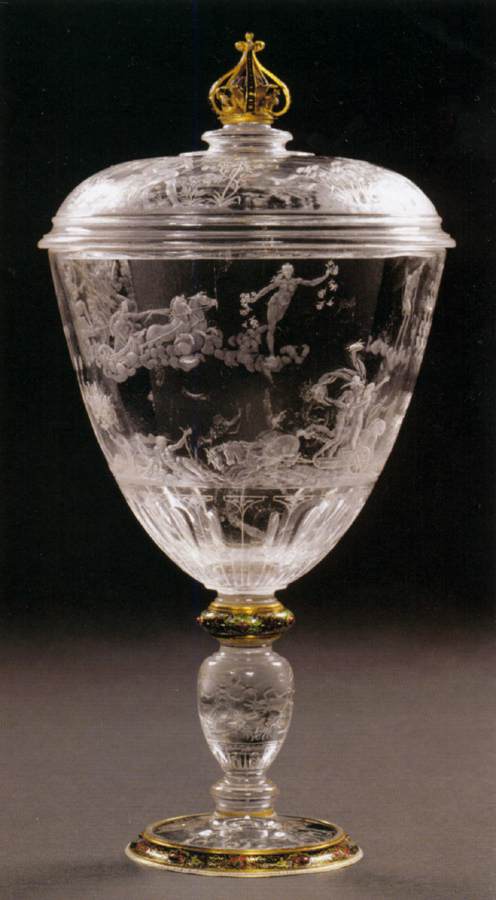
Italian sculptor, medalist, and engraver. He came from a family of Swiss origin, from Ticino, and was active mainly in Milan. According to Giovanni Paolo Lomazzo, his great friend, Fontana in his early career, before 1570, was active mainly making medalsGLOSSARYThe medal came to artistic maturity within a remarkably short time of its introduction in 15th century Italy. This was partly because ancient Roman coins, which were beginning to be reverently collected, suggested (on a smaller scale) its form: profile portrait bust on the obverse, a different design on the reverse, an inscription running round the rim. Like the finest Imperial coins, the medal's purpose was commemorative. Without monetary value, and of non-precious metal (bronze or lead), it was a way of circulating a likeness to a chosen few; it anticipated the use of miniatures and was indeed frequently worn round the neck. And while the reverse could record a historical event or make a propaganda point related to its subject's career, more commonly it bore a design that purported to convey the 'essence', as it were, of the person portrayed on the other side. Given the admiration for the men and artefacts of ancient Rome, the stress on individual character, the desire for fame and the penchant for summing up temperament in symbols and images, it is easy to understand how quickly the fashion for commissioning medals spread. Its pioneer executant was Pisanello. The precedents before he began to cast medals in 1438-39 had been few and excessively coin-like. Within 10 years he had established the form the medal was to retain until the influence was registered of the reverseless, hollow-cast and wafer-thin medals of the 1560s and 70s made by Bombarda (Andrea Cambi). Pisanello's approach was first echoed by the Veronese Matteo de' Pasti (d. 1467-688). It was, perhaps oddly, not until the works from 1485 of Niccolò Fiorentino (Niccolò di Forzore Spinelli, 1430-1514) that Florence produced a medallist of the highest calibre. Other specialists in the medium included Sperandio (Sperandio Savelli, c. 1425-1504), L'Antico (Pier Jacopo Alari Bonacolsi, c. 1460-1528), Caradosso (Cristoforo Caradosso Foppa, 1452-1526/27). The work of these men, and of the many, often anonymous, who reflected them, is still coveted because it avoided the two medallistic errors: making a medal look like either an enlarged piece of money or a small sculptured plaque. and engravingGLOSSARYA print made from a metal plate that has had a design cut into it with a sharp point. Ink is smeared over the plate and then wiped off, the ink remaining in the etched lines being transferred when the plate is pressed very firmly onto a sheet of paper. on rock crystal and hardstones (pietre dure). Based on references in Lomazzo, portraitGLOSSARYThe Roman portrait bust survived in the form of life-sized reliquaries of saints, but it was in 15th century Florence that the individual features and character of a contemporary sitter were accurately recorded by sculptors such as Donatello, Desiderio da Settignano, Mino da Fiesole and the Rossellino. A similar degree of realism occurs in 15th century tomb sculpture. The equestrian portrait, based on antique statues such as the Marcus Aurelius monument (Rome, Campidoglio), was revived in the 14th century. Two examples in fresco are Simone Martini's Guidoriccio (c. 1328; Siena, Palazzo Pubblico) and the posthumous portrait of Sir John Hawkwood (1436; Florence, Cathedral) by Uccello, which gives the illusion of a 3-dimensional statue seen from below. The Venetian Republic ordered imposing monuments from Donatello (1447; Gattarnelata, Padua) and Verrocchio (14799; Colleoni, Venice), whilst other statesmen ordered their own images to be erected in public places, directly relating themselves to the military heroes of ancient Rome. Another form of political portraiture derived from antiquity was the commemorative portrait medal designed by artists such as Pisanello. The carved or painted profile portrait became popular in the 1450s. The realism of the clear, flattened image, painted under the influence of Flemish examples by the Pollaiuolo brothers, Piero della Francesca and Botticelli, was superseded by the three-quarter and frontal portrait, psychologically more complex, such as Leonardo's enigmatic Mona Lisa (Paris, Louvre) with her momentary smile or Andrea del Sarto's arresting Portrait of a Man (London, National Gallery). The 16th century portrait became generalized, Lotto's Andrea Odoni (1527; Royal Collection) being an idealized concept of a collector rather than an individual. Group portraits, decorating whole rooms, include the narrative scenes of the Gonzaga court painted by Mantegna (completed 1474; Mantua, Palazzo Ducale) and the elaborate schemes commissioned by the Farnese family in Rome from Vasari (1546; Palazzo della Cancelleria) and Salviati (after 1553; Palazzo Farnese). Portraits were also incorporated into religious narratives, as in Ghirlandaio's fresco cycle painted for Giovanni Tornabuoni in S. Maria Novella, Florence (1486-90). medals of Francesco Ferdinando d'Avalos and Lomazzo have been attributed to Fontana. The status and occupations of the subjects of his medals indicate that Fontana was in contact with patrons of high rank and with the intellectual circles of Milan. Stylistically, the three medals derive from Leone Leoni and Jacopo da Trezzo I (c. 1517-1589), and these influences continued in his work.
Fontana's rock crystal engravings were in great demand by aristocratic patrons. The numerous crystal engravings attributed to Fontana are distinguished by a masterly use of space, with active figures showing the influence of Michelangelo mediated through that of Leoni. Examples are - among others - in the Residenz, Munich; in the Kunsthistorisches Museum, Vienna; in the Metropolitan Museum, New York; and in the Walters Art Museum, Baltimore.
From 1570 he turned increasingly to sculpture. The first reference to Fontana as a marbleGLOSSARYloosely applied to any hard limestone that can be sawn into thin slabs and will take a good polish so that it is suitable for decorative work; more strictly, it refers to metamorphosed limestones whose structure has been recrystallized by heat or pressure. Marbles are widely disseminated and occur in a great variety of colours and patterns, but certain types have been particularly prized by sculptors. The most famous of Greek white marbles in the ancient world was the close-grained Pentelic, which was quarried at Mount Pentelicon in Attica. The Elgin Marbles are carved in Pentelic. Widely used also were the somewhat coarser-grained translucent white marbles from the Aegean islands of Paros and Naxos. Parian marble was used for the celebrated Mausoleum at Halicarnassus. The pure white Carrara marble, quarried at Massa, Carrara, and Pietra Santa in Tuscany from the 3rd century BC, is the most famous of all sculptors' stones. It was used for the Apollo Belvedere, and was much favoured in the Renaissance, particularly by Michelangelo, who often visited the quarries to select material for his work. Neoclassical sculptors also favoured Carrara marble because of its ability to take a smooth, sleek surface, but it can look rather 'dead' compared with some of the finest Greek marbles. sculptor dates from 1570, when he is documented in Palermo in connection with a valuation of reliefs by Vincenzo Gagini (1527–95) for the portalGLOSSARYa doorway. A portal recessed in several steps was frequently used in Romanesque architecture; this meant that the often relatively small entrance was given considerable emphasis on the façade. of the cathedralGLOSSARYThe principal church of a province or diocese, where the throne of the bishop is placed. For reasons lost to time and tradition, a cathedral always faces west - toward the setting sun. The altar is placed at the east end. The main body, or nave, of the cathedral is usually divided into one main and two side aisles. These lead up to the north and south transepts, or arms of the cross, the shape in which a cathedral is usually formed. there. His presence in Palermo is important evidence of his contact with the Gagini family workshop and also supports the hypothesis that he visited Rome and saw work there by followers of Michelangelo, particularly Guglielmo della Porta.
Fontana returned to Milan by 1572 and two years later entered the service of the Fabbrica (Church Works) of Santa Maria presso San Celso. All his known work as a sculptor was made for this church and is well documented in its archives. He collaborated with Stoldo di Gino Lorenzi on the façade of the church. The quality of this work indicates that he was already experienced in the field of large-scale sculpture, although no earlier example by him is known. His first two statues for the façadeGLOSSARYthe front or principal face of a building, especially one elaborately constructed; a blind façade is a façade that is purely decorative and does not relate to the structure of the building. were the prophets Isaiah and Jeremiah (1575–76), for the niches of the upper order. The statues of Sibyls (1577–79) reclining on the tympanumGLOSSARYIn classical architecture, the triangular area enclosed by a pediment, often decorated with sculptures. In medieval architecture, the semi-circular area over a a door's lintel, enclosed by an arch, often decorated with sculptures or mosaics. of the main portal, which have deep-cut drapery and expressive faces, derive from Michelangelo and della Porta.
From 1580 to 1583 Fontana executed three large reliefs for the façade: the Adoration of the Shepherds, the Presentation at the Temple and the Marriage at Cana. Fontana next executed statues of the Assumption of the Virgin and two Angels for the pinnacleGLOSSARYa small turret-like architectural feature, often richly ornamented, that crowns parapets, pediments above windows or doors, flying buttresses, spires, tec.. The contract of 1583 specified four angels, two praying and two singing. Only the latter were carved by him, however; the praying angels were completed to his design after his death by Milano Vimercati (active 1577–1593). Two wax models for the Angels (Museum of Art, Cleveland; Los Angeles County Museum of Art, Los Angeles) are rare surviving 16th-century examples in perishable material.
Fontana also worked on statues for the interior of the church, including St John the Evangelist (1583–87) for a niche to the right of the main altar and an Assumption of the Virgin (1583–86) for the altar of the Vergine dei Miracoli.