03 — ARTWORK
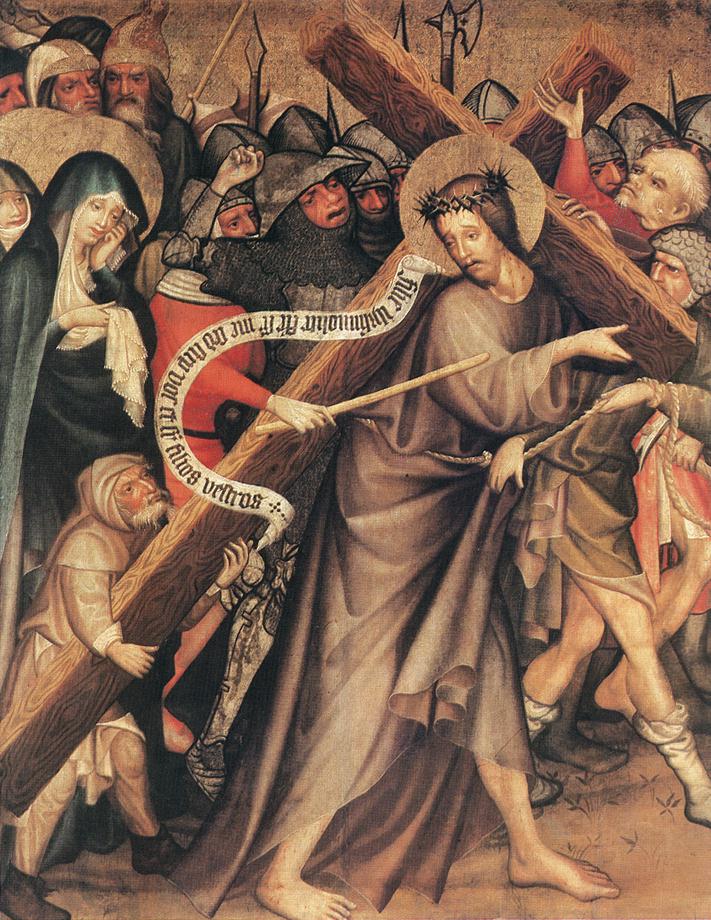
Christ Carrying the Cross
MASTER THOMAS de Coloswar · 1427 →
- MEDIUM
- Tempera on pine, 87 X 68.5 cm
- TYPE
- Religious
PALETTE
HOVER OR TAP A SWATCH FOR NAME, SHARE AND HEX. SAMPLED FROM THE IMAGE — INDICATIVE, NOT A PIGMENT ANALYSIS.
DEVELOPMENT BUILD — NOT FOR PUBLIC USE. CONTRIBUTE ON GITHUB.
CURRENT LOCATION · Christian Museum
03 — ARTWORK
MASTER THOMAS de Coloswar · 1427 →
PALETTE
HOVER OR TAP A SWATCH FOR NAME, SHARE AND HEX. SAMPLED FROM THE IMAGE — INDICATIVE, NOT A PIGMENT ANALYSIS.
COMMENTARY
UNDERLINED TERMS ARE DEFINED IN THE GLOSSARY.
Christ Carrying the Cross 1427 TemperaA method of painting in which the pigments are mixed with an emulsion of water and egg yolks or whole eggs (sometimes glue or milk). Tempera was widely used in Italian art in the 14th and 15th centuries, both for panel painting and fresco, then being replaced by oil paint. Tempera colors are bright and translucent, though because the paint dried very quickly there is little time to blend them, graduated tones being created by adding lighter or darker dots or lines of color to an area of dried paint. on pine, 87 X 68.5 cm Christian Museum, Esztergom
The picture shows one of the panels of the Garamszentbenedek AltarpieceA picture or sculpture that stands on or is set up behind an altar. The term reredos is used for an ornamental screen or partition, not directly attached to the altar table but affixed to the wall behind it. A diptych is an altarpiece consisting of two panels, a triptych one of three panels, and a polyptych one of four or more panels. From the 14th to 16th century, the altarpiece was one of the most important commissions in European art; it was through the altarpiece that some of the most decisive developments in painting and sculpture came about..
In contrast to the external panels of the altarpiece, which all represent scenes taking place out of doors, a rhomboid-patterned golden surface provides the background to the PassionThe events leading up to Good Friday, beginning with Christ's arrest and ending with his burial. Portrayals of the Passion, which focus on the Suffering Christ, include depictions of Judas betraying Christ with a kiss, Peter cutting off Malchus's ear, the crown of thorns, and so on. scenes depicted on the internal wings. These panels are chiefly connected with the courtly art of Burgundy and with the entourage of the Duc de Berry.
In the lower field of the right-hand panelTerm in painting for a support of wood, metal, or other rigid substance, as distinct from canvas. Until the adoption of canvas in the 15th century nearly all the movable paintings of Europe were executed on wood, and even up to the beginning of the 17th century it is probable that as much painting was done on the one support as on the other. Painters who worked on a small scale often used copper panels (Elsheimer is a leading example), and in the colonial art of South America copper and tin and even lead and zinc were used. On a larger scale, slate has occasionally been used as a support, notably by Rubens for his altarpiece for Sta Maria in Vallicella (the Chiesa Nuova) in Rome; the picture he originally painted was said to reflect the light unpleasantly and slate was used for the replacement to produce a more matt finish. For wood panels the Italian masters of the Renaissance preferred white poplar, while oak was the most common wood used in northern Europe. Many other types were used, however; analysis of the contents of art galleries has yielded a long list, including beech, cedar, chestnut, fir, larch, linden, mahogany, olive, and walnut. In the 20th century cedar, teak, and dark walnut are favourites, and modern painters have also used plywood, fibre-board, and other synthetic materials as supports. Christ, in front of a crowd of furious soldiers, carries the cross on his shoulder to Golgotha. The Virgin and a holy woman follow him, while the end of the cross is supported by Simon of Cyrene, depicted on a smaller scale. Christ's words are to be ead on the inscribed scroll: "Daughters of Jerusalem weep not over me, but weep for yourselves and for our children." The long beam of the cross is placed along the principal diagonal line of the picture and the halo of Christ covers the point of intersection of the beams. The striking veins of the wood give a particular emphasis to the huge cross. Thomas de Coloswar may have been attracted by this task, engrossing him to such an extent that he forgot about connecting the annual rings on the different sides of the cross.
Despite the brutal countenances and the coarse gestures of the soldiers the basic tone of the scene is not dramatic. Christ's face is expressing sadness rather than suffering, nor is the Virgin tortured by the agony of the moment; she is rather submerged into more profound sorrow, surprassing the actual event. The process, mentioned in the introduction, can be observed in this picture in the course of its development; a process in which the artist picks out certain motifs from the narrative of events , and transforms and displays them for the purpose of private devotion. The thick cross seems to push back the soldiers figures and even the figure pulling Christ by a rope round His waist is ousted from the foreground. The giant figure of Christ becomes rigid as if it were a character in a tableau vivant: He stops in His course, addressing the holy women. And yet, this is not a really epic scene either: turning to the spectator He looks into space, and the inscribed scroll, whose semicircular part touches the Virgin s mantleAn overcoat, worn open, popular during the second half of the 15th century and the 16th century and often lined with fur along the hem and around the collar. It reached to the knee or foot, depending on the social class of the wearer., tells the spectator His words to the women. The scroll separates and, at the same time, points to the figure of Christ, almost putting Him into a frame. By this it makes the hand of the soldier in red, who strikes Him with a stick, symbolic. There is only one single step to leaving out the mercenaries' figures - and the devotional picture is complete for the purpose of private worship. The same tendency is shown by the mode in which the Virgin's figure is depicted. Her face does not reflect the shattering effect of the events which are taking place, but rather presents a state of inward reflection and of meditation.
The archive catalogues no further works by this artist.
TRY SAME COLLECTION →@online{wga-rf1491527d5b933,
author = {Krén, Emil and Marx, Daniel},
title = {Christ Carrying the Cross by MASTER THOMAS de Coloswar},
organization = {{Web Gallery of Art}},
date = {2026-09-13},
url = {https://beta.wga.hu/artists/master-thomas-de-coloswar-r87d8de447dbb86/christ-carrying-the-cross-rf1491527d5b933},
urldate = {2026-09-13},
langid = {english}
}ACCESSED 2026-09-13. REPLACE THE AUTHOR FIELD WITH THE COMMENTARY AUTHOR WHERE ONE IS NAMED.


