03 — ARTWORK
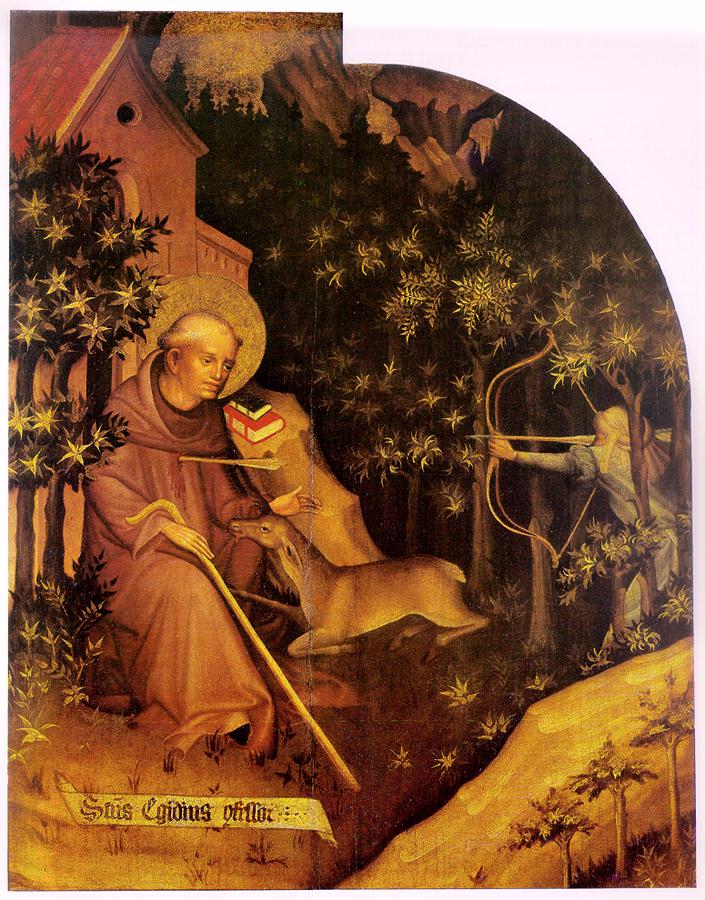
The Death of St Giles
MASTER THOMAS de Coloswar · 1427 →
- MEDIUM
- Tempera on pine wood, 89,5 x 69 cm
- TYPE
- Religious
PALETTE
HOVER OR TAP A SWATCH FOR NAME, SHARE AND HEX. SAMPLED FROM THE IMAGE — INDICATIVE, NOT A PIGMENT ANALYSIS.
DEVELOPMENT BUILD — NOT FOR PUBLIC USE. CONTRIBUTE ON GITHUB.
CURRENT LOCATION · Christian Museum
03 — ARTWORK
MASTER THOMAS de Coloswar · 1427 →
PALETTE
HOVER OR TAP A SWATCH FOR NAME, SHARE AND HEX. SAMPLED FROM THE IMAGE — INDICATIVE, NOT A PIGMENT ANALYSIS.
COMMENTARY
UNDERLINED TERMS ARE DEFINED IN THE GLOSSARY.
Nicholas, a canon of Gyõr, who was also cantor of the royal chapela small separate place for worship, either part of a large church or a separate building. in Buda Castle, in 1427 commissioned Master Thomas, painter of Coloswar (Kolozsvár) to make a polyptychA painting (usually an altarpiece) made up of a number of panels fastened together. Some polyptychs were very elaborate, the panels being housed in richly carved and decorated wooden frameworks. Duccio's "Maestà" (1308-1311) is a well-known example. for the high altar of the Abbey Church at Garamszentbenedek (today Hronsky Benadik, Slovakia). Ending in a pointed archIn architecture, an arch rising to a point (instead of being round, as in classical architecture). The pointed arch is characteristic of Gothic architecture., the central picture of the polyptych (which consists of nine panels) represents the CrucifixionAn important method of capital punishment, particularly among the Persians, Seleucids, Jews, Carthaginians, and Romans from about the 6th century BC to the 4th century AD. Constantine the Great, the first Christian emperor, abolished it in the Roman Empire in AD 337, out of veneration for Jesus Christ, the most famous victim of crucifixion. There were various methods of performing the execution. Usually, the condemned man, after being whipped, or "scourged," dragged the crossbeam of his cross to the place of punishment, where the upright shaft was already fixed in the ground. Stripped of his clothing either then or earlier at his scourging, he was bound fast with outstretched arms to the crossbeam or nailed firmly to it through the wrists. The crossbeam was then raised high against the upright shaft and made fast to it about 9 to 12 feet (approximately 3 metres) from the ground. Next, the feet were tightly bound or nailed to the upright shaft. A ledge inserted about halfway up the upright shaft gave some support to the body; evidence for a similar ledge for the feet is rare and late. Over the criminal's head was placed a notice stating his name and his crime. Death, apparently caused by exhaustion or by heart failure, could be hastened by shattering the legs (crurifragium) with an iron club, so that shock and asphyxiation soon ended his life., the internal wings are decorated with four episodes of the PassionThe events leading up to Good Friday, beginning with Christ's arrest and ending with his burial. Portrayals of the Passion, which focus on the Suffering Christ, include depictions of Judas betraying Christ with a kiss, Peter cutting off Malchus's ear, the crown of thorns, and so on. and the external ones with scenes taken from the lives of several saints. (One of the latter has been lost, and so has the predellaAn Italian word for the small strip of paintings which forms the lower edge or socle of a large altarpiece (pala). Such a polyptych consists of a principal, central panel with subsidiary side and/or top panels, and a predella: the predella usually has narrative scenes from the lives of the Saints who are represented in the panels above. Because of the small size of predelle - they are not usually more than 25-30 cm high, though often relatively very wide - they were frequently used for pictorial experiments that the painter did not wish to risk making in the larger panels. The first datable example seems to be that in Simone Martini's S. Louis of Toulouse (1317, Naples). with the inscription about the donation.) The panelTerm in painting for a support of wood, metal, or other rigid substance, as distinct from canvas. Until the adoption of canvas in the 15th century nearly all the movable paintings of Europe were executed on wood, and even up to the beginning of the 17th century it is probable that as much painting was done on the one support as on the other. Painters who worked on a small scale often used copper panels (Elsheimer is a leading example), and in the colonial art of South America copper and tin and even lead and zinc were used. On a larger scale, slate has occasionally been used as a support, notably by Rubens for his altarpiece for Sta Maria in Vallicella (the Chiesa Nuova) in Rome; the picture he originally painted was said to reflect the light unpleasantly and slate was used for the replacement to produce a more matt finish. For wood panels the Italian masters of the Renaissance preferred white poplar, while oak was the most common wood used in northern Europe. Many other types were used, however; analysis of the contents of art galleries has yielded a long list, including beech, cedar, chestnut, fir, larch, linden, mahogany, olive, and walnut. In the 20th century cedar, teak, and dark walnut are favourites, and modern painters have also used plywood, fibre-board, and other synthetic materials as supports. representing St Giles is the top quarter of the external wing on the right, its rounded corner following the line of the archThe pointed arch is widely regarded as the main identifiable feature of Gothic architecture (distinct from the round arch of the Romanesque period). The three most common Gothic arches are the Equilateral, Lancet and Tudor. of the central picture.
The hermit, who lived in a forest, was nurtured by the milk of a tame hind. The king's huntsmen pursued the animal, but when the saint interceded with the hunter he aimed his arrow at the holy man and instead of wounding the deer it pierced St Giles's breast. This moment is recorded in the painting. The saint bears the pain with a meditative, pious countenance. The arrow is depicted in the picture twice, perhaps because a single arrow rushing in the air may have introduced too great a tension and lack of balance into this lyrical scene. The hind taking refuge with the hermit is also characterized by calm stillness. The artist may have used a drawing from a model-book of the period for this work, which is indicated not only by the calmness of the animal as if it were part of a still life, but also by its movement: the model of the animal looks as if it had been drawn with all four legs underneath it, but the painter, adjusting the model to the painting, represented its right foreleg streched out. Though the hunter s figure is much smaller than that of St Giles, the lines of the rock in the foreground and the light colours of the foliage of the forest seem to lead one's eyes to him. In accordance with the style, which had a predilection for elegant, curving lines, the painter stressed the impressive and buoyant line of the bow, which is beautifully set off by the darkness of the forest.
In the international life of King Sigismund of Luxembourg's court at Buda, Thomas de Coloswar had an opportunity to become familiar with the leading movements in painting of the period. The panel representing St Giles has similarities to Bohemian art. The rocky, wooded landscape - to quote Antal Hekler - "the colour of a fairytale in spite of its awakening realismRealism (with an upper case "R"), also known as the Realist school, denotes a mid-nineteenth century art movement and style in which artists discarded the formulas of Neoclassicism and the theatrical drama of Romanticism to paint familiar scenes and events as they actually looked. Typically it involved some sort of sociopolitical or moral message, in the depiction of ugly or commonplace subjects. One of the main representatives and spokesmen was the painter Gustave Courbet. In the dispute about ways to represent reality, Realism rebelled against the idealistic and classicist tendencies in painting." reveals features akin to the art of the Master of Trebon and the illuminators working under his influence.
The archive catalogues no further works by this artist.
TRY SAME COLLECTION →@online{wga-rafac5478dd30c5,
author = {Krén, Emil and Marx, Daniel},
title = {The Death of St Giles by MASTER THOMAS de Coloswar},
organization = {{Web Gallery of Art}},
date = {2026-09-13},
url = {https://beta.wga.hu/artists/master-thomas-de-coloswar-r87d8de447dbb86/the-death-of-st-giles-rafac5478dd30c5},
urldate = {2026-09-13},
langid = {english}
}ACCESSED 2026-09-13. REPLACE THE AUTHOR FIELD WITH THE COMMENTARY AUTHOR WHERE ONE IS NAMED.


