03 — ARTWORK
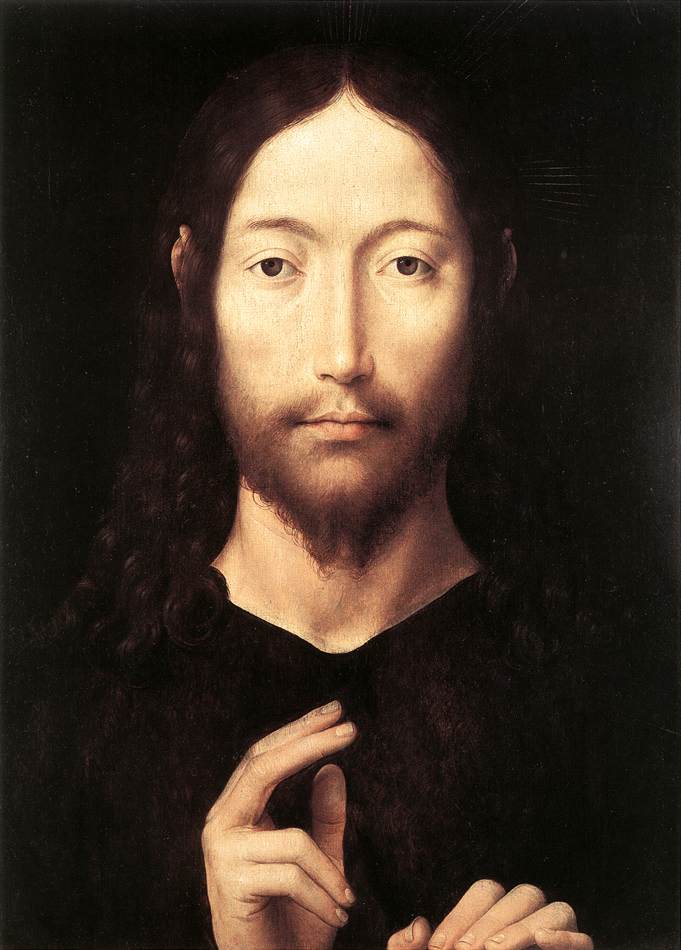
Christ Giving His Blessing
- MEDIUM
- Oil on oak panel, 38,1 x 28,2 cm
- TYPE
- Religious
PALETTE
HOVER OR TAP A SWATCH FOR NAME, SHARE AND HEX. SAMPLED FROM THE IMAGE — INDICATIVE, NOT A PIGMENT ANALYSIS.
DEVELOPMENT BUILD — NOT FOR PUBLIC USE. CONTRIBUTE ON GITHUB.
03 — ARTWORK
PALETTE
HOVER OR TAP A SWATCH FOR NAME, SHARE AND HEX. SAMPLED FROM THE IMAGE — INDICATIVE, NOT A PIGMENT ANALYSIS.
COMMENTARY
UNDERLINED TERMS ARE DEFINED IN THE GLOSSARY.
Memling painted a slightly different version of this composition in 1481. The type can be interpreted iconographically as the merging of the 'Vera Effigies' and 'Salvator Mundi'. It comprises a frontal portrayal of the face of Christ in a manner that had become standard in fifteenth-century art, having been established as early as the thirteenth century by a description contained in the so-called Letter of Lentulus. The best-known example of this theme was executed by Jan van Eyck. The figure is transformed by Memling into a Salvator Mundi giving his blessing, but without the attributes of his power. He does not hold a crossed orb in his hand or wear a coronet on his head, but is presented in the form of a portraitThe Roman portrait bust survived in the form of life-sized reliquaries of saints, but it was in 15th century Florence that the individual features and character of a contemporary sitter were accurately recorded by sculptors such as Donatello, Desiderio da Settignano, Mino da Fiesole and the Rossellino. A similar degree of realism occurs in 15th century tomb sculpture. The equestrian portrait, based on antique statues such as the Marcus Aurelius monument (Rome, Campidoglio), was revived in the 14th century. Two examples in fresco are Simone Martini's Guidoriccio (c. 1328; Siena, Palazzo Pubblico) and the posthumous portrait of Sir John Hawkwood (1436; Florence, Cathedral) by Uccello, which gives the illusion of a 3-dimensional statue seen from below. The Venetian Republic ordered imposing monuments from Donatello (1447; Gattarnelata, Padua) and Verrocchio (14799; Colleoni, Venice), whilst other statesmen ordered their own images to be erected in public places, directly relating themselves to the military heroes of ancient Rome. Another form of political portraiture derived from antiquity was the commemorative portrait medal designed by artists such as Pisanello. The carved or painted profile portrait became popular in the 1450s. The realism of the clear, flattened image, painted under the influence of Flemish examples by the Pollaiuolo brothers, Piero della Francesca and Botticelli, was superseded by the three-quarter and frontal portrait, psychologically more complex, such as Leonardo's enigmatic Mona Lisa (Paris, Louvre) with her momentary smile or Andrea del Sarto's arresting Portrait of a Man (London, National Gallery). The 16th century portrait became generalized, Lotto's Andrea Odoni (1527; Royal Collection) being an idealized concept of a collector rather than an individual. Group portraits, decorating whole rooms, include the narrative scenes of the Gonzaga court painted by Mantegna (completed 1474; Mantua, Palazzo Ducale) and the elaborate schemes commissioned by the Farnese family in Rome from Vasari (1546; Palazzo della Cancelleria) and Salviati (after 1553; Palazzo Farnese). Portraits were also incorporated into religious narratives, as in Ghirlandaio's fresco cycle painted for Giovanni Tornabuoni in S. Maria Novella, Florence (1486-90)., as a human being standing in a window, his left hand resting on the frame. He is the counterpart of the Man of SorrowsA depiction of Christ during his Passion, bound, marked by flagellation, and crowned with thorns., the suffering Christ, as depicted by Memling in Genoa. In fact, the dark blue-green background and dark brownish-purple robe render the latter a kind of agonised metamorphosis of the Pasadena Christ.
The immediate typological precursor of this presentation is the Master of Flémalle's Salvator Mundi (Philadelphia, John G. Johnson Collection) in which the fingers of the left hand are also just visible above the edge. Christ himself, the form of his robe and the position of the hand with which he gives his blessing are a development on the Jean de Braque triptychA painting in three sections, usually an altarpiece, consisting of a central panel and two outer panels, or wings. In many medieval triptychs the two outer wings were hinged so that could be closed over the center panel. Early triptychs were often portable. by Rogier van der Weyden. Although created at a much earlier date and less robust and more transparent in its execution, the Pasadena version is readily comparable with Memling's Christ with musical angels in Antwerp. The rounded, almost sculptural features, the softly flowing hair of the beard and moustache, the fingers with their round tips in almost the same position of blessing, are all very similar. The underdrawing of the Pasadena work reveals that the hand making the blessing was designed on the panelTerm in painting for a support of wood, metal, or other rigid substance, as distinct from canvas. Until the adoption of canvas in the 15th century nearly all the movable paintings of Europe were executed on wood, and even up to the beginning of the 17th century it is probable that as much painting was done on the one support as on the other. Painters who worked on a small scale often used copper panels (Elsheimer is a leading example), and in the colonial art of South America copper and tin and even lead and zinc were used. On a larger scale, slate has occasionally been used as a support, notably by Rubens for his altarpiece for Sta Maria in Vallicella (the Chiesa Nuova) in Rome; the picture he originally painted was said to reflect the light unpleasantly and slate was used for the replacement to produce a more matt finish. For wood panels the Italian masters of the Renaissance preferred white poplar, while oak was the most common wood used in northern Europe. Many other types were used, however; analysis of the contents of art galleries has yielded a long list, including beech, cedar, chestnut, fir, larch, linden, mahogany, olive, and walnut. In the 20th century cedar, teak, and dark walnut are favourites, and modern painters have also used plywood, fibre-board, and other synthetic materials as supports. itself. Several of its contours do not match the painted form at all, and the latter was itself corrected several times, even after the dark brown colour of the robe had already been painted around the fingers. The ring and little finger were originally drawn closer together, and the forefinger and index finger were more bent. Christ's hand in Antwerp is more or less the finished result of the Pasadena version, though in a more elongated form.
@online{wga-r86388af57d2789,
  author       = {Krén, Emil and Marx, Daniel},
  title        = {Christ Giving His Blessing by MEMLING, Hans},
  organization = {{Web Gallery of Art}},
  date         = {2026-09-09},
  url          = {https://beta.wga.hu/artists/memling-hans-r4666dbd4a024c7/christ-giving-his-blessing-r86388af57d2789},
  urldate      = {2026-09-09},
  langid       = {english}
}
ACCESSED 2026-09-09. REPLACE THE AUTHOR FIELD WITH THE COMMENTARY AUTHOR WHERE ONE IS NAMED.


