03 — ARTWORK
St John Altarpiece (central panel)
- MEDIUM
- Oil on oak panel, 173,6 x 173,7 cm
- TYPE
- Religious
PALETTE
HOVER OR TAP A SWATCH FOR NAME, SHARE AND HEX. SAMPLED FROM THE IMAGE — INDICATIVE, NOT A PIGMENT ANALYSIS.
DEVELOPMENT BUILD — NOT FOR PUBLIC USE. CONTRIBUTE ON GITHUB.
03 — ARTWORK
PALETTE
HOVER OR TAP A SWATCH FOR NAME, SHARE AND HEX. SAMPLED FROM THE IMAGE — INDICATIVE, NOT A PIGMENT ANALYSIS.
COMMENTARY
UNDERLINED TERMS ARE DEFINED IN THE GLOSSARY.
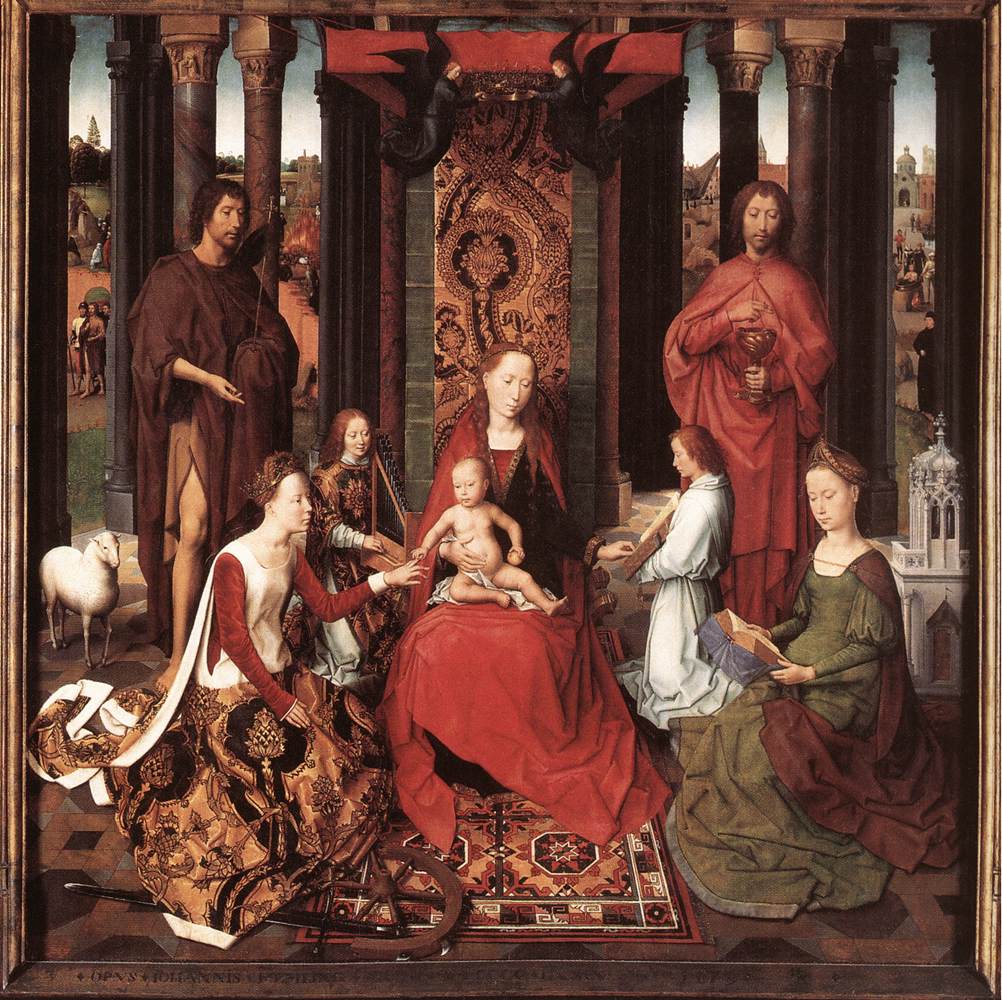
The central panelTerm in painting for a support of wood, metal, or other rigid substance, as distinct from canvas. Until the adoption of canvas in the 15th century nearly all the movable paintings of Europe were executed on wood, and even up to the beginning of the 17th century it is probable that as much painting was done on the one support as on the other. Painters who worked on a small scale often used copper panels (Elsheimer is a leading example), and in the colonial art of South America copper and tin and even lead and zinc were used. On a larger scale, slate has occasionally been used as a support, notably by Rubens for his altarpiece for Sta Maria in Vallicella (the Chiesa Nuova) in Rome; the picture he originally painted was said to reflect the light unpleasantly and slate was used for the replacement to produce a more matt finish. For wood panels the Italian masters of the Renaissance preferred white poplar, while oak was the most common wood used in northern Europe. Many other types were used, however; analysis of the contents of art galleries has yielded a long list, including beech, cedar, chestnut, fir, larch, linden, mahogany, olive, and walnut. In the 20th century cedar, teak, and dark walnut are favourites, and modern painters have also used plywood, fibre-board, and other synthetic materials as supports. focuses upon a Sacra ConversazioneA representation of the Virgin and Child attended by saints. There is seldom a literal conversation depicted, though as the theme developed the interaction between the participants - expressed through gesture, glance and movement - greatly increased. The saints depicted are usually the saint the church or altar is dedicated to, local saints, or those chosen by the patron who commissioned the work., a gathering of saints around the Virgin. Mary is enthroned on a golden seat and is being crowned Queen of Heaven by two dark-blue angels who hover above her. St Catherine kneels on one side, recognisable by the instruments of her martyrdomthe sufferings, torture and death inflicted on a person on account of his faith or convictions., the sword and wheel, and from the wedding ritual. The attributeA symbolic object which is conventionally used to identify a particular person, usually a saint. In the case of martyrs, it is usually the nature of their martyrdom. of St Barbara, kneeling on the other side, is represented as a white stone sacrament tower. The Eucharistic Host is visible through the traceried window in a glass cylinder mounted on a crescent moon. Although the Host was another attribute of this saint, it may also be interpreted here as an allusion to the Holy Mass - symbolismAn artistic movement that arose in France toward the end of the nineteenth century, primarily in literature, in opposition to the reigning schools of Realism and Impressionism. Symbolism rejected objectivity in favour of the subjective, and turned away from the direct representation of reality in favour of a synthesis of many different aspects of it, aiming to suggest ideas by means of ambiguous yet powerful symbols. Among the artists associated with the movement were Odilon Redon, Gustave Moreau and Puvis de Chavannes in France, Fernand Khnopff in Belgium, Jan Toorop in Holland, Ferdinand Hodler in Switzerland, Gustave Klimt in Austria, and Giovanni Segantini in Italy. which is continued throughout the remainder of the scene.
The standing figures of the two St Johns on either side of the Virgin in the middle ground personify aspects of the Eucharistthe sacrament of Holy Communion, celebrated with bread and wine, the most sacred moment of the Christian liturgy.. St John the Baptist with the lamb at his side points with his right hand to the incarnated Jesus, the true sacrificial Lamb, who holds an apple in his hand to indicate that he is the new Adam. St John the Evangelist blesses his poisoned chaliceA cup used in the celebration of the Christian Eucharist. Both the statement of St. Paul about "the cup of blessing which we bless" (1 Corinthians 10:16) and the accounts of the institution of the Eucharist in the first three Gospels indicate that special rites of consecration attended the use of the chalice from the beginning. It was not until the recognition of Christianity by the Roman Empire in the 4th century that silver and gold became the usual materials for the chalice. In the Middle Ages the legend of the Holy Grail surrounded the origins of the eucharistic chalice with a magical aura. The precious stones and elaborate carvings employed for the embellishment of chalices have made them an important part of the history of ecclesiastical art. in the manner of the priest during Mass. The sacral nature of the scene heightens the significance of the book held up to the Virgin by the angel kneeling like an acolyte on the right, and the music played by the angel with the portative organ on the left. Mary functions as a kind of divine, consecratory altar. The overall scene is thus a vision of the Eucharist. The composition of the group is perfectly symmetrical, as is the architectural construction to the rear that encloses them. It is a kind of apseA semicircular projection, roofed with a half-dome, at the east end of a church behind the altar. Smaller subsidiary apses may be found around the choir or transepts. Also known as an exedra. The adjective is apsidal., with an ambulatorySemicircular or polygonal circulation space enclosing an apse or a straight-ended sanctuary., without walls or windows.
Memling was doubtlessly influenced by the architecture in Jan van Eyck's Virgin with Canon van der Paele, which he opened up and elongated to form a series of light columns, thus taking the setting a stage further. Six brownish-red, round marbleloosely applied to any hard limestone that can be sawn into thin slabs and will take a good polish so that it is suitable for decorative work; more strictly, it refers to metamorphosed limestones whose structure has been recrystallized by heat or pressure. Marbles are widely disseminated and occur in a great variety of colours and patterns, but certain types have been particularly prized by sculptors. The most famous of Greek white marbles in the ancient world was the close-grained Pentelic, which was quarried at Mount Pentelicon in Attica. The Elgin Marbles are carved in Pentelic. Widely used also were the somewhat coarser-grained translucent white marbles from the Aegean islands of Paros and Naxos. Parian marble was used for the celebrated Mausoleum at Halicarnassus. The pure white Carrara marble, quarried at Massa, Carrara, and Pietra Santa in Tuscany from the 3rd century BC, is the most famous of all sculptors' stones. It was used for the Apollo Belvedere, and was much favoured in the Renaissance, particularly by Michelangelo, who often visited the quarries to select material for his work. Neoclassical sculptors also favoured Carrara marble because of its ability to take a smooth, sleek surface, but it can look rather 'dead' compared with some of the finest Greek marbles. columns stand in a semi-circle on a tile floor. They are surrounded by a second crescent of dark-grey composite piers, whose bases are linked by the straight edges of the floor, which thus forms a polygonal footing for the architecture. A simplified version of this construction is to be found in Memling's Granada Virgin. The floor-pattern is repeated several times in his work. Allowing for the aberrations arising from manual execution, the perspectiveThe method of representing three-dimensional objects on a flat surface. Perspective gives a picture a sense of depth. The most important form of perspective in the Renaissance was linear perspective (first formulated by the architect Brunelleschi in the early 15th century), in which the real or suggested lines of objects converge on a vanishing point on the horizon, often in the middle of the composition (centralized perspective). The first artist to make a systematic use of linear perspective was Masaccio, and its principles were set out by the architect Alberti in a book published in 1436. The use of linear perspective had a profound effect on the development of Western art and remained unchallenged until the 20th century. is systematic and geometrically correct. The narrow vertical openings between the columns reveal a continuous landscape with ruins and buildings in which small episodes from the lives of the two male saints are enacted. The two wings each depict one such incident in enlarged form in the foreground. In addition to these realistic portrayals, the carved groups on the two capitals above each saint also depict key moments from their lives. The scenes connected with the altarpieceA picture or sculpture that stands on or is set up behind an altar. The term reredos is used for an ornamental screen or partition, not directly attached to the altar table but affixed to the wall behind it. A diptych is an altarpiece consisting of two panels, a triptych one of three panels, and a polyptych one of four or more panels. From the 14th to 16th century, the altarpiece was one of the most important commissions in European art; it was through the altarpiece that some of the most decisive developments in painting and sculpture came about.'s principal figures are not, however, the only action going on in the landscape. There is a third background scene which, though interwoven spatially with the others, actually relates to the donors, namely the clerics of St John's Hospital in Bruges. It depicts the measuring of imported wine at the city crane by a monk from the hospital (behind St John the Baptist), and another monk on the far right, half obscured by a columna vertical structural member having a circular cross-section and usually consisting of a base, a long shaft, and a capital.. This striking and detailed little figure was once taken erroneously for a self-portraitThe Roman portrait bust survived in the form of life-sized reliquaries of saints, but it was in 15th century Florence that the individual features and character of a contemporary sitter were accurately recorded by sculptors such as Donatello, Desiderio da Settignano, Mino da Fiesole and the Rossellino. A similar degree of realism occurs in 15th century tomb sculpture. The equestrian portrait, based on antique statues such as the Marcus Aurelius monument (Rome, Campidoglio), was revived in the 14th century. Two examples in fresco are Simone Martini's Guidoriccio (c. 1328; Siena, Palazzo Pubblico) and the posthumous portrait of Sir John Hawkwood (1436; Florence, Cathedral) by Uccello, which gives the illusion of a 3-dimensional statue seen from below. The Venetian Republic ordered imposing monuments from Donatello (1447; Gattarnelata, Padua) and Verrocchio (14799; Colleoni, Venice), whilst other statesmen ordered their own images to be erected in public places, directly relating themselves to the military heroes of ancient Rome. Another form of political portraiture derived from antiquity was the commemorative portrait medal designed by artists such as Pisanello. The carved or painted profile portrait became popular in the 1450s. The realism of the clear, flattened image, painted under the influence of Flemish examples by the Pollaiuolo brothers, Piero della Francesca and Botticelli, was superseded by the three-quarter and frontal portrait, psychologically more complex, such as Leonardo's enigmatic Mona Lisa (Paris, Louvre) with her momentary smile or Andrea del Sarto's arresting Portrait of a Man (London, National Gallery). The 16th century portrait became generalized, Lotto's Andrea Odoni (1527; Royal Collection) being an idealized concept of a collector rather than an individual. Group portraits, decorating whole rooms, include the narrative scenes of the Gonzaga court painted by Mantegna (completed 1474; Mantua, Palazzo Ducale) and the elaborate schemes commissioned by the Farnese family in Rome from Vasari (1546; Palazzo della Cancelleria) and Salviati (after 1553; Palazzo Farnese). Portraits were also incorporated into religious narratives, as in Ghirlandaio's fresco cycle painted for Giovanni Tornabuoni in S. Maria Novella, Florence (1486-90). of the artist. However, close examination reveals his features to be those of Jacob de Ceuninc. St John's Church, which no longer exists, can be made out next to the column to the right of the wooden crane, from where it could be seen. It forms yet another allusion to the St John theme.
@online{wga-re682fdec4b2f2e,
  author       = {Krén, Emil and Marx, Daniel},
  title        = {St John Altarpiece (central panel) by MEMLING, Hans},
  organization = {{Web Gallery of Art}},
  date         = {2026-09-13},
  url          = {https://beta.wga.hu/artists/memling-hans-r4666dbd4a024c7/st-john-altarpiece-central-panel-re682fdec4b2f2e},
  urldate      = {2026-09-13},
  langid       = {english}
}
ACCESSED 2026-09-13. REPLACE THE AUTHOR FIELD WITH THE COMMENTARY AUTHOR WHERE ONE IS NAMED.