03 — ARTWORK
St John Altarpiece
- MEDIUM
- Oil on oak panel, 173,6 x 173,7 cm (central), 176 x 78,9 cm (each wing)
- TYPE
- Religious
PALETTE
HOVER OR TAP A SWATCH FOR NAME, SHARE AND HEX. SAMPLED FROM THE IMAGE — INDICATIVE, NOT A PIGMENT ANALYSIS.
DEVELOPMENT BUILD — NOT FOR PUBLIC USE. CONTRIBUTE ON GITHUB.
03 — ARTWORK
PALETTE
HOVER OR TAP A SWATCH FOR NAME, SHARE AND HEX. SAMPLED FROM THE IMAGE — INDICATIVE, NOT A PIGMENT ANALYSIS.
COMMENTARY
UNDERLINED TERMS ARE DEFINED IN THE GLOSSARY.
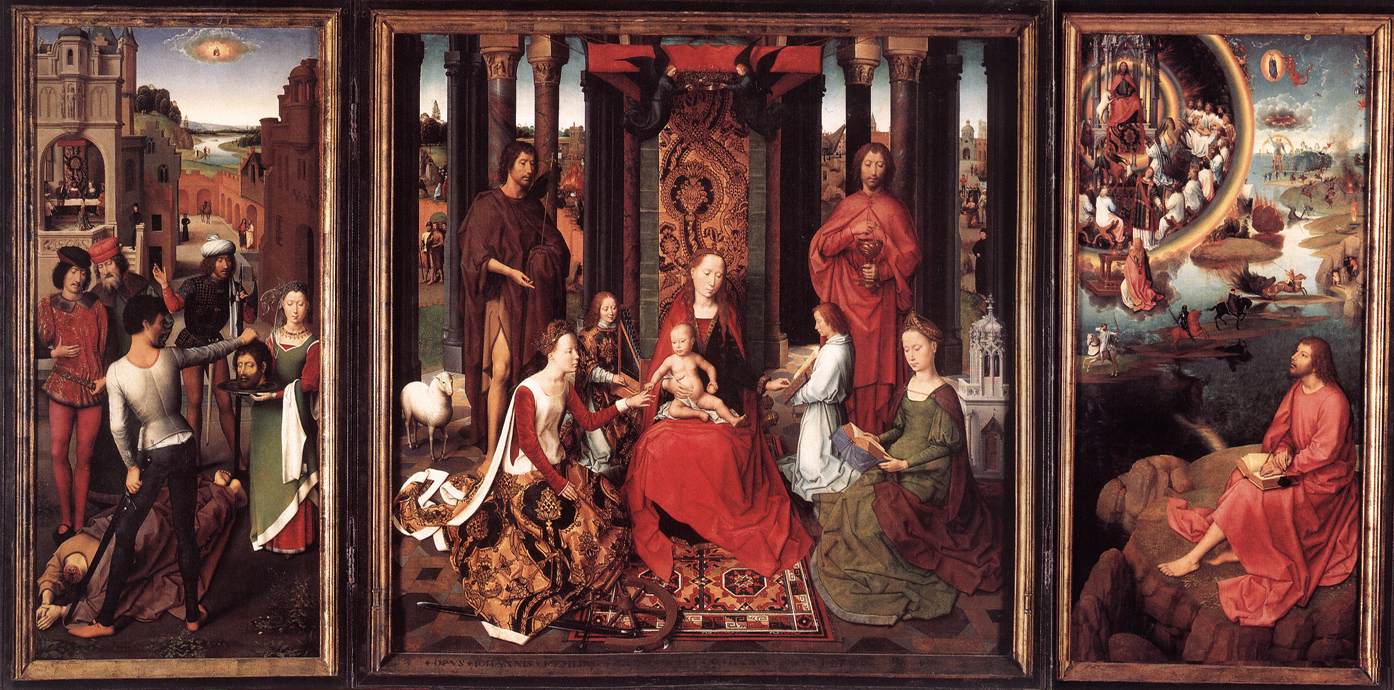
The symbolic gesture whereby Jesus places a wedding ring on the finger of St Catherine of Alexandria caused this altarpieceA picture or sculpture that stands on or is set up behind an altar. The term reredos is used for an ornamental screen or partition, not directly attached to the altar table but affixed to the wall behind it. A diptych is an altarpiece consisting of two panels, a triptych one of three panels, and a polyptych one of four or more panels. From the 14th to 16th century, the altarpiece was one of the most important commissions in European art; it was through the altarpiece that some of the most decisive developments in painting and sculpture came about. to be identified for many years as the Mystic marriage of St Catherine. Nevertheless, it is clearly dedicated to the Virgin and the two St Johns. Together with the Gdansk Last Judgment and the Lübeck PassionThe events leading up to Good Friday, beginning with Christ's arrest and ending with his burial. Portrayals of the Passion, which focus on the Suffering Christ, include depictions of Judas betraying Christ with a kiss, Peter cutting off Malchus's ear, the crown of thorns, and so on., this is one of the three biggest triptychs that Memling ever painted. The three altarpieces are also distributed evenly throughout his career, and hence serve as crucial milestones in the development of his oeuvreThe complete body of works created by an artist.. The St John altarpiece is dated 1479, and is thus located precisely half-way between the Gdansk (1467) and Lübeck (1491) triptychs.
The central panelTerm in painting for a support of wood, metal, or other rigid substance, as distinct from canvas. Until the adoption of canvas in the 15th century nearly all the movable paintings of Europe were executed on wood, and even up to the beginning of the 17th century it is probable that as much painting was done on the one support as on the other. Painters who worked on a small scale often used copper panels (Elsheimer is a leading example), and in the colonial art of South America copper and tin and even lead and zinc were used. On a larger scale, slate has occasionally been used as a support, notably by Rubens for his altarpiece for Sta Maria in Vallicella (the Chiesa Nuova) in Rome; the picture he originally painted was said to reflect the light unpleasantly and slate was used for the replacement to produce a more matt finish. For wood panels the Italian masters of the Renaissance preferred white poplar, while oak was the most common wood used in northern Europe. Many other types were used, however; analysis of the contents of art galleries has yielded a long list, including beech, cedar, chestnut, fir, larch, linden, mahogany, olive, and walnut. In the 20th century cedar, teak, and dark walnut are favourites, and modern painters have also used plywood, fibre-board, and other synthetic materials as supports. focuses upon a Sacra ConversazioneA representation of the Virgin and Child attended by saints. There is seldom a literal conversation depicted, though as the theme developed the interaction between the participants - expressed through gesture, glance and movement - greatly increased. The saints depicted are usually the saint the church or altar is dedicated to, local saints, or those chosen by the patron who commissioned the work., a gathering of saints around the Virgin. However, the narrow vertical openings between the columns reveal a continuous landscape with ruins and buildings in which small episodes from the lives of the two male saints are enacted. The two wings each depict episodes from the lives of the standing figures of the two St Johns on either side of the Virgin. The left wing features the Beheading of St John the Baptist and the right wing St John the Evangelist on the Island of Patmos. In addition to these realistic portrayals, the carved groups on the two capitals above each saint also depict key moments from their lives.
The composition of the triptychA painting in three sections, usually an altarpiece, consisting of a central panel and two outer panels, or wings. In many medieval triptychs the two outer wings were hinged so that could be closed over the center panel. Early triptychs were often portable. as a whole is not only ingenious in narrative terms, with the different components interlocking spatially and thematically; it is also new in many respects as far as the portrayal of the Virgin Mary in heaven and the Apocalypsethe Revelation of St John, the last book of the New Testament. The wrath of God descending upon the earth is depicted in three visions; in the form of terrible natural catastrophes, in the battle between the forces and good and evil, and in the union of a new Heaven and new Earth in the Heavenly Jerusalem. The announcement of the Second Coming of Christ at the end of the world was intended to console the persecuted Christians and also prepare them for the horrors connected with the event. are concerned. The iconographical forebears of such a grouping of saints sitting and standing around an enthroned Virgin are few and far between. The only extant examples are, in fact, the Virgo inter Virgines from the circle of the Master of Flémalle in Washington and a similar composition, this time set in a room, by Rogier van der Weyden, several fragments of which have survive. They are not, however, comparable in formal terms. This clear monumental composition, with two symmetrical standing male saints and two sitting female saints, forming a tetramorph around the Virgin, must have seemed very new. As is the case with the architecture, Memling appears to have developed here upon Jan van Eyck's Virgin with Canon van der Paele. The Apocalypse is new too. There is no sign of any other representation prior to Memling in which the Book of Revelation is played out before St John's eyes in its entirety in a single, undivided painting. Only in the Beheading of StJohn the Baptist did Memling prefer to paraphrase a Van der Weyden composition (St John altarpiece, Berlin, Staatliche Museen). However, the stylised terseness and enclosed character of the latter give way here to dramatic action in the open air, with a high degree of realismRealism (with an upper case "R"), also known as the Realist school, denotes a mid-nineteenth century art movement and style in which artists discarded the formulas of Neoclassicism and the theatrical drama of Romanticism to paint familiar scenes and events as they actually looked. Typically it involved some sort of sociopolitical or moral message, in the depiction of ugly or commonplace subjects. One of the main representatives and spokesmen was the painter Gustave Courbet. In the dispute about ways to represent reality, Realism rebelled against the idealistic and classicist tendencies in painting..
In view of the historical circumstances and iconographyThe systematic study and identification of the subject-matter and symbolism of art works, as opposed to their style; the set of symbolic forms on which a given work is based. Originally, the study and identification of classical portraits. Renaissance art drew heavily on two iconographical traditions: Christianity, and ancient Greek and Roman art, thought and literature., there can be no doubt whatsoever that this triptych was painted for the High Altar of the chapela small separate place for worship, either part of a large church or a separate building. of St John's Hospital. An old inscription on the bottom member of the frame gives the date 1479 and the name of the artist Johannes Memling. With the exception of the Floreins triptych in the same hospital, this is the only work by Memling to be authenticated by an original (in this case subsequently overpainted) inscription. The donors were also identified. Jacob de Ceuninc was initially recorded as a monk at the hospital in 1469-70, and later as bursar from 1488 until his death in 1490. Antheunis Seghers was first mentioned in 1455-56 and appears to have been master from 1461 to 1465, bursar from 1466 to 1468, and then master again from 1469 until his death in 1475. Agnes Casembrood was first recorded in 1445-46, and subsequently appears as prioress from 1459 to 1463, and again from 1469 until her death in 1489. Clara van Hulsen makes her initialthe first letter of the text in medieval manuscripts and early printed books, made to stand out emphatically by its colour, size, and ornamentation. appearance in the records in 1427-1428, and died in 1479. Given that these are evidently intended as portraits, the altarpiece must have been ordered before the death of Antheunis Seghers in 1475, which means that its production may logically be linked with the expansion of the chapel's apseA semicircular projection, roofed with a half-dome, at the east end of a church behind the altar. Smaller subsidiary apses may be found around the choir or transepts. Also known as an exedra. The adjective is apsidal. in 1473- 74 though we lack details of Jacob de Ceuninc and Clara van Hulsen in those years.
The altarpiece is, of course, dedicated to the patron saints of St John's Hospital. The central portrayal of the Virgin might relate to the hospital chapel's long-standing and close links with the chapter of the almost adjacent Church of Our Lady. The two female saints, Catherine and Barbara, were frequently invoked in adversity. Their presence in the hospital context has frequently been explained in terms of their symbolising respectively the contemplative and active life of the hospital's monastic community.
@online{wga-rd681090db42abc,
  author       = {Krén, Emil and Marx, Daniel},
  title        = {St John Altarpiece by MEMLING, Hans},
  organization = {{Web Gallery of Art}},
  date         = {2026-09-09},
  url          = {https://beta.wga.hu/artists/memling-hans-r4666dbd4a024c7/st-john-altarpiece-rd681090db42abc},
  urldate      = {2026-09-09},
  langid       = {english}
}
ACCESSED 2026-09-09. REPLACE THE AUTHOR FIELD WITH THE COMMENTARY AUTHOR WHERE ONE IS NAMED.