03 — ARTWORK
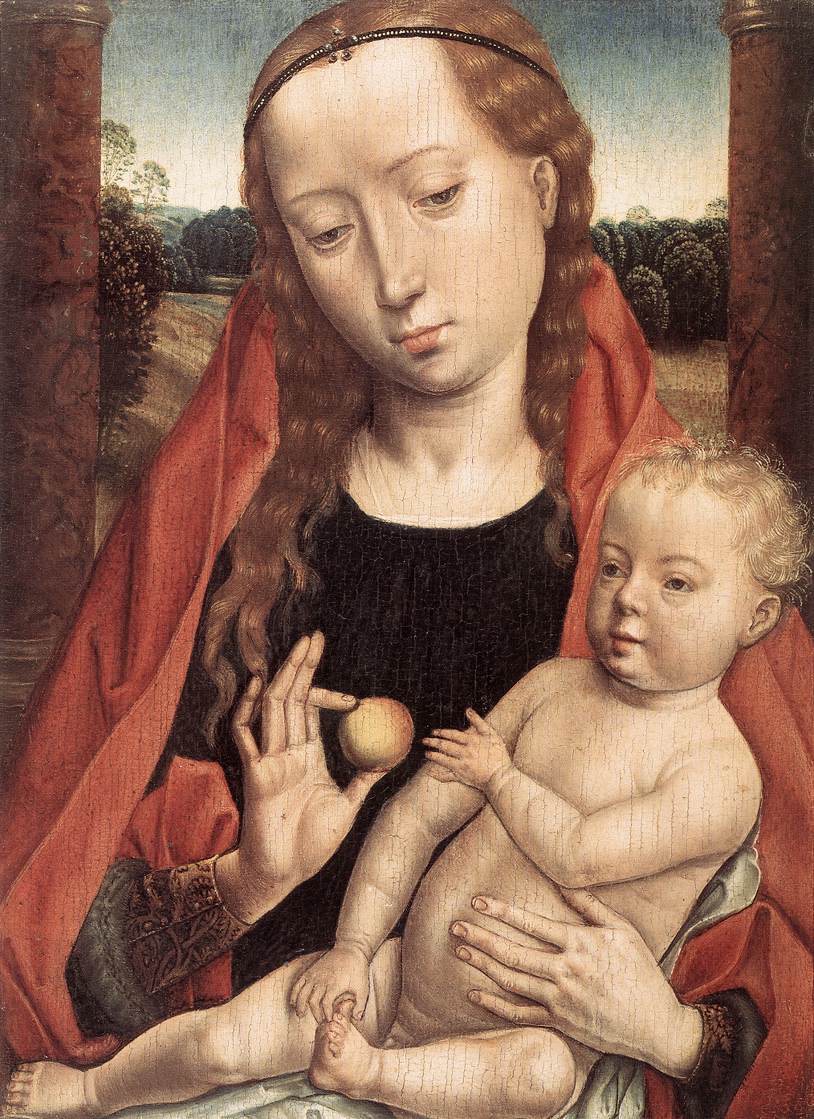
Virgin with the Child Reaching for his Toe
- MEDIUM
- Oil on oak panel, 24,1 x 17,8 cm
- TYPE
- Religious
PALETTE
HOVER OR TAP A SWATCH FOR NAME, SHARE AND HEX. SAMPLED FROM THE IMAGE — INDICATIVE, NOT A PIGMENT ANALYSIS.
DEVELOPMENT BUILD — NOT FOR PUBLIC USE. CONTRIBUTE ON GITHUB.
03 — ARTWORK
PALETTE
HOVER OR TAP A SWATCH FOR NAME, SHARE AND HEX. SAMPLED FROM THE IMAGE — INDICATIVE, NOT A PIGMENT ANALYSIS.
COMMENTARY
UNDERLINED TERMS ARE DEFINED IN THE GLOSSARY.
The Virgin is in a loggiaA gallery or room open on one or more sides, its roof supported by columns. Loggias in Italian Renaissance buildings were generally on the upper levels. Renaissance loggias were also separate structure, often standing in markets and town squares, that could be used for public ceremonies. contained at the back by two small columns in reddish-brown marbleloosely applied to any hard limestone that can be sawn into thin slabs and will take a good polish so that it is suitable for decorative work; more strictly, it refers to metamorphosed limestones whose structure has been recrystallized by heat or pressure. Marbles are widely disseminated and occur in a great variety of colours and patterns, but certain types have been particularly prized by sculptors. The most famous of Greek white marbles in the ancient world was the close-grained Pentelic, which was quarried at Mount Pentelicon in Attica. The Elgin Marbles are carved in Pentelic. Widely used also were the somewhat coarser-grained translucent white marbles from the Aegean islands of Paros and Naxos. Parian marble was used for the celebrated Mausoleum at Halicarnassus. The pure white Carrara marble, quarried at Massa, Carrara, and Pietra Santa in Tuscany from the 3rd century BC, is the most famous of all sculptors' stones. It was used for the Apollo Belvedere, and was much favoured in the Renaissance, particularly by Michelangelo, who often visited the quarries to select material for his work. Neoclassical sculptors also favoured Carrara marble because of its ability to take a smooth, sleek surface, but it can look rather 'dead' compared with some of the finest Greek marbles. and offering a view onto a wooded landscape. In front, on a parapet cut across by the edge of the painting, the Infant Christ sits on a cloth. He is restrained by the Virgin's left hand and from her right hand he is about to receive an apple, while with his own right hand he playfully reaches for his toe.
In terms of its composition and typologyA system of classification. In Christian thought, the drawing of parallels between the Old Testament and the New. Typological studies were based on the assumption that Old Testament figures and events prefigured those in the New, e.g. the story of Jonah and the whale prefigured Christ's death and resurrection. Such typological links were frequently used in both medieval and Renaissance art., the painting exhibits the well-known Memling characteristics, but technically it is heavily executed with rough modelling of the hands, the features and the drapery. It has clearly been painted by an average follower of Memling. Similar robust features and a face with rather oriental eyes are to be seen in a number of other Memlingian Virgins at half length. So a master can be assumed who has concentrated mainly on imitating Memling's Virgin-and-Child types.
The fact that the composition was repeated again and again and even by great painters such as Juan de Flandes and Jan Provoost indicates that a lost Memling prototype must have existed.
@online{wga-r8855290aaf19ae,
  author       = {Krén, Emil and Marx, Daniel},
  title        = {Virgin with the Child Reaching for his Toe by MEMLING, Hans},
  organization = {{Web Gallery of Art}},
  date         = {2026-09-13},
  url          = {https://beta.wga.hu/artists/memling-hans-r4666dbd4a024c7/virgin-with-the-child-reaching-for-his-toe-r8855290aaf19ae},
  urldate      = {2026-09-13},
  langid       = {english}
}
ACCESSED 2026-09-13. REPLACE THE AUTHOR FIELD WITH THE COMMENTARY AUTHOR WHERE ONE IS NAMED.


