03 — ARTWORK
Pulpit
- MEDIUM
- Marble, height 461 cm
- TYPE
- Religious
PALETTE
HOVER OR TAP A SWATCH FOR NAME, SHARE AND HEX. SAMPLED FROM THE IMAGE — INDICATIVE, NOT A PIGMENT ANALYSIS.
DEVELOPMENT BUILD — NOT FOR PUBLIC USE. CONTRIBUTE ON GITHUB.
03 — ARTWORK
PALETTE
HOVER OR TAP A SWATCH FOR NAME, SHARE AND HEX. SAMPLED FROM THE IMAGE — INDICATIVE, NOT A PIGMENT ANALYSIS.
COMMENTARY
UNDERLINED TERMS ARE DEFINED IN THE GLOSSARY.
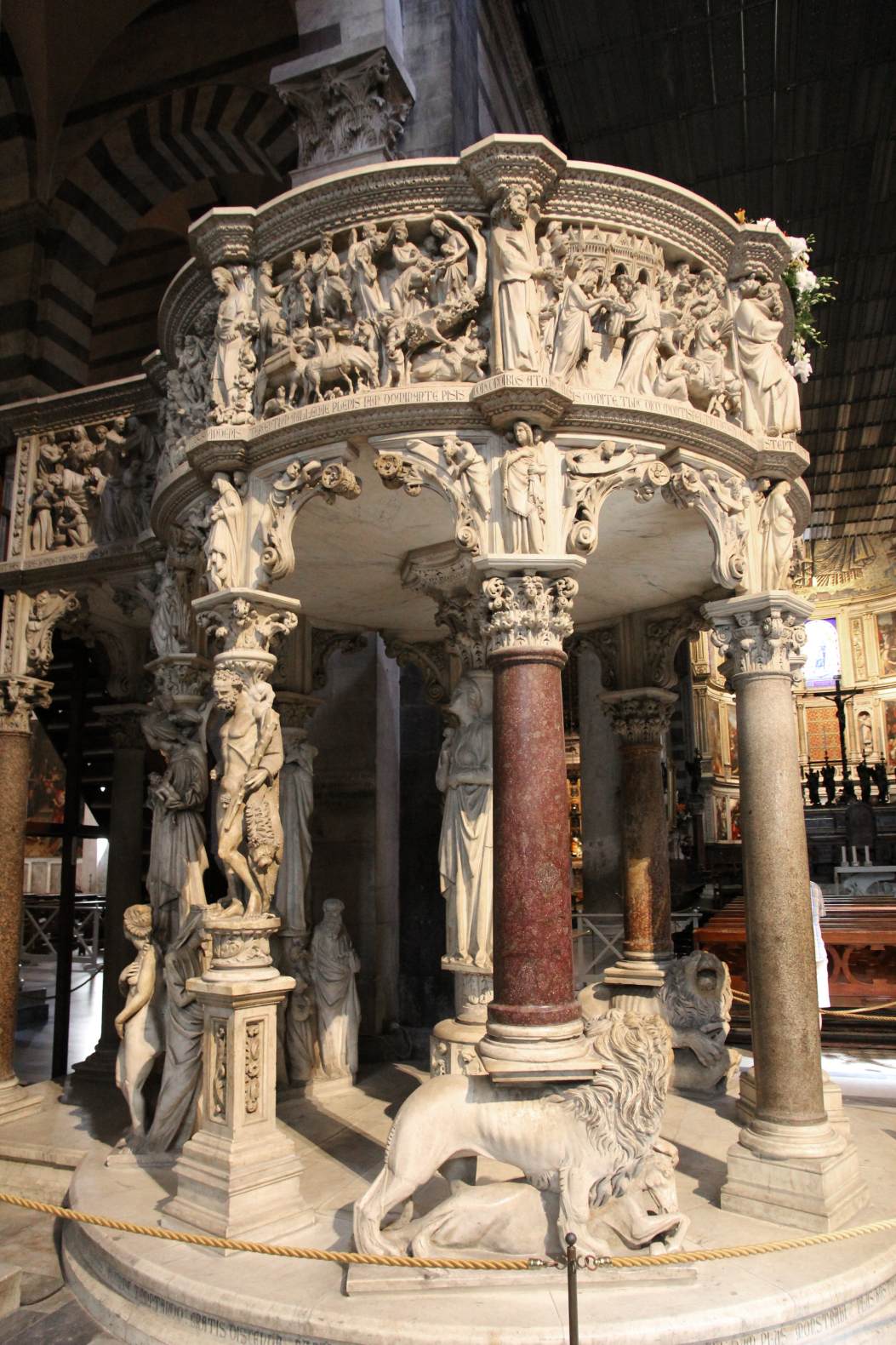
Giovanni Pisano's pulpit in Pisa CathedralThe principal church of a province or diocese, where the throne of the bishop is placed. For reasons lost to time and tradition, a cathedral always faces west - toward the setting sun. The altar is placed at the east end. The main body, or nave, of the cathedral is usually divided into one main and two side aisles. These lead up to the north and south transepts, or arms of the cross, the shape in which a cathedral is usually formed., probably commissioned by Burgundio di Tadio, Operaio of the Cathedral Works, who is recorded in the inscription, was made between 1302 and 1310; it replaced an earlier pulpit by Guglielmo, now in Cagliari Cathedral. The pulpit was dismantled after a fire in 1595 and has suffered much damage from restorations, particularly those in 1926-29; its present position, between two of the navethe main interior space of a church building. It may have parallel aisles on each side, often separated from it by pillars, and is intersected by the transept, which cuts across it at the point where the choir begins. columns instead of under the domein architecture, hemispherical structure evolved from the arch, usually forming a ceiling or roof., makes it impossible to view it in the round.
This, the most sumptuous of the Pisano pulpits, is of unprecedented size; it is dominated by the sense of continuous, multi-directional movement and frenetic energy. The interpretation of its complex iconographic programme, probably at least partly devised by the DominicansA Roman Catholic order of mendicant friars founded by St. Dominic in 1216 to spread the faith through preaching and teaching. The Dominicans were one of the most influential religious orders in the later Middle Ages, their intellectual authority being established by such figures as Albertus Magnus and St.Thomas Aquinas. The Dominicans played the leading role in the Inquisition. of Santa Caterina, Pisa, is controversial, and many of the symbols and allegories of the pulpit bear more than one level of sometimes conflicting meaning; the female (known as the Mater) figure of the basemolded foot of a pillar or column providing the transition from the plinth to the shaft., for example, has been successively interpreted as Pisa, Eve, Jerusalem, Ecclesia, Mary, Charity, and Mother Earth. The themes and sequences of the programme were prescribed by the patrons, but they were absorbed by Giovanni into his own harsh and dramatic vision, and he may have influenced the choice of some of the scenes.
The octagonal pulpit has a central support formed by three caryatids, clearly modelled on ClassicalRelating to the culture of ancient Greece and Rome (classical Antiquity). The classical world played a profoundly important role in the Renaissance, with Italian scholars, writers, and artists seeing their own period as the rebirth (the "renaissance") of classical values after the Middle Ages. The classical world was considered the golden age for the arts, literature, philosophy, and politics. Concepts of the classical, however, changed greatly from one period to the next. Roman literature provided the starting point in the 14th century, scholars patiently finding, editing and translating a wide range of texts. In the 15th century Greek literature, philosophy and art - together with the close study of the remains of Roman buildings and sculptures-expanded the concept of the classical and ensured it remained a vital source of ideas and inspiration. prototypes and representing Faith, Hope, and Charity; they stand on an octagonal pedestal adorned with figures of the Liberal ArtsThese represented the subject matter of the secular 'arts' syllabus of the Middle Ages; first the preparatory trivium - grammar, rhetoric and dialectic, then the basis of a philosophical training, the quadrivium, comprising arithmetic, geometry, astronomy and music. By the 13th century each had been given a pictorial identity, together with identifying attributes (e.g. a measuring rod for geometry) and exemplars (e.g. Pythagoras for arithmetic, Tubal for music).While treated with a stylistic variety that reflected current pictorial concerns, whether with iconographic completeness (Andrea da Firenze in the Spanish Chapel at S. Maria Novella in Florence), or with narrative (Pinturicchio in the Vatican) or with the nude (Pollaiuolo's tomb of Sixtus IV in St Peter's), the theme was left remarkably intact by artists whose own activity (save through the mathematics of perspective) was excluded from it as manual rather than liberal. and Philosophy. The outer supports consist of columns standing on low plinths or lions, or of full-length figures: the Mater, her pedestal surrounded by the Four Cardinal Virtuesthe four principle virtues of Temperantia (Temperance), Fortitudo (Fortitude), Prudentia (Prudence) and Justitia (Justice) that were adopted from Plato (427-347 BC) in Christian ethics. Gregory the Great (540-604 AD) added the three so-called Theological Virtues of Fides (Faith), Spes (Hope) and Caritas (Love/Charity). At the height of the Middle Ages, this Christian system of Virtues was further extended. (the Prudence figure is based on an Antiquethe classical age of Greece and Rome began with the Greek migrations of the 2nd millennium BC, and ended in the West in 476 AD with the deposition of the Roman emperor Romulus Augustulus (c. 475 AD); in the East it ended in 529 AD when the Platonic Academy was closed by Justinian (482 - 565 AD). Venus Pudica); Christ with the Four Evangelists; St Michael; and Hercules. Above rise the arches richly carved with exuberant acanthusa thistle species very common in the Mediterranean. Its large, jagged leaves, curving in slightly at the tips, have been a favorite ornamental pattern since classical antiquity. scrolls, with Prophets in the spandrels and standing SibylsIn antiquity, women who could prophesy. The many Sibylline prophecies were kept in Rome and consulted by the Senate. In Christian legend, Sibyls foretold the Birth, Passion and Resurrection of Christ, just as the male prophets of the Bible did. Originally, in the period of classical antiquity, there was only one Sibyl; the number gradually rose to ten. In early Christianity it was further raised to 12, in analogy to the 12 prophets of the Old Testament. above the capitals.
The parapet, set between corbelled cornices, appears to be circular, but the statues at the corners, set on projecting, semicircular platforms, define its octagonal plan. On the eightGroup of American painters who exhibited together only once, in New York City in 1908, but who established one of the main currents in 20th-century American painting. The original Eight included Robert Henri, leader of the group, Everett Shinn, John Sloan, Arthur B. Davies, Ernest Lawson, Maurice Prendergast, George Luks, and William J. Glackens. George Bellows later joined them. The group’s determination to bring art into closer touch with everyday life greatly influenced the course of American art. sides are reliefs with narrative scenes.
<ol> <li>Annunciationthe term for the event described in the Gospel according to St. Luke, when the Angel Gabriel brings the Virgin Mary the news that she is to bear her son, Jesus Christ. The Annunciation was among the most widespread pictorial subjects of European art during the Middle Ages and the Renaissance., Visitation, and Birth of St John the Baptist</li> <li>Nativity and Annunciation to the Shepherds</li> <li>Dream and Adoration of the Magi</li> <li>Presentation in the Temple, Herod and the Magi, the Angel Warning the Holy Family to Flee, and the Flight into Egypt</li> <li>Massacre of the Innocents</li> <li>PassionThe events leading up to Good Friday, beginning with Christ's arrest and ending with his burial. Portrayals of the Passion, which focus on the Suffering Christ, include depictions of Judas betraying Christ with a kiss, Peter cutting off Malchus's ear, the crown of thorns, and so on. scenes</li> <li>CrucifixionAn important method of capital punishment, particularly among the Persians, Seleucids, Jews, Carthaginians, and Romans from about the 6th century BC to the 4th century AD. Constantine the Great, the first Christian emperor, abolished it in the Roman Empire in AD 337, out of veneration for Jesus Christ, the most famous victim of crucifixion. There were various methods of performing the execution. Usually, the condemned man, after being whipped, or "scourged," dragged the crossbeam of his cross to the place of punishment, where the upright shaft was already fixed in the ground. Stripped of his clothing either then or earlier at his scourging, he was bound fast with outstretched arms to the crossbeam or nailed firmly to it through the wrists. The crossbeam was then raised high against the upright shaft and made fast to it about 9 to 12 feet (approximately 3 metres) from the ground. Next, the feet were tightly bound or nailed to the upright shaft. A ledge inserted about halfway up the upright shaft gave some support to the body; evidence for a similar ledge for the feet is rare and late. Over the criminal's head was placed a notice stating his name and his crime. Death, apparently caused by exhaustion or by heart failure, could be hastened by shattering the legs (crurifragium) with an iron club, so that shock and asphyxiation soon ended his life.</li> <li>Last Judgment (in two parts)</li> </ol>
An effect of opposing tensions is created by the densely crowded figures that project at different angles and in different directions, the twisted draperies and the necks bent in sudden movements. The climax of dramatic intensity is reached in the Massacre of the Innocents. The contrast between the rough, sketchy modelling in some of the Passion scenes, for example, and the more translucent statues of the base, and between the sense of overflowing energy in the figures of the upper part of the pulpit and the calmer, classicizing figures of the base - the severe Mater and the introspective Hercules - demonstrates the vast range of Giovanni's expressive powers.
The pulpit was originally coloured, as described in later documents, but only traces of this remain: backgrounds were rendered in blue and gold enamelColoured glass in powder form and sometimes bound with oil, which is bonded to a metal surface or plaque by firing., draperies were painted red and blue, faces were tinted pink with dark pupils to the eyes, and gold was used for crowns and borders.
@online{wga-r1519268cdb2763,
  author       = {Krén, Emil and Marx, Daniel},
  title        = {Pulpit by PISANO, Giovanni},
  organization = {{Web Gallery of Art}},
  date         = {2026-09-09},
  url          = {https://beta.wga.hu/artists/pisano-giovanni-r1e2bda68beedd5/pulpit-r1519268cdb2763},
  urldate      = {2026-09-09},
  langid       = {english}
}
ACCESSED 2026-09-09. REPLACE THE AUTHOR FIELD WITH THE COMMENTARY AUTHOR WHERE ONE IS NAMED.


