02 — ARTIST
PISANO, Giovanni
b. 1250 Pisa · d. 1314 Pisa
DEVELOPMENT BUILD — NOT FOR PUBLIC USE. CONTRIBUTE ON GITHUB.
02 — ARTIST
b. 1250 Pisa · d. 1314 Pisa
BIOGRAPHY
Nicola and Giovanni Pisano, Italian sculptors and architects, father and son. They were the greatest sculptors of their period and stand at the head of the tradition of Italian sculpture in the same way that Giotto stands at the head of the tradition of Italian painting. They often worked together, but their styles are distinctive.
Nicola came from Apulia, where the emperor Frederick II (d. 1250) had encouraged a classical revival, and his first known work, the pulpit in the Baptistery at Pisa (dated 1260 Pisan style, i.e. 1259) shows his brilliant adaptation of antique forms to a new context. He transformed a Dionysus into Simeon at the Presentation of Christ, a nude Hercules into a personification of Christian Fortitude, and a Phaedra into the Virgin Mary. But instead of following the Romanesque convention of separating episodes into compartments arranged in bands, he combined them into the formal unity of single pictures on each side of the pulpit with great power and dramatic effect. Several of the figures were directly inspired by ancient sarcophagi that Nicola saw in the Campo Santo in Pisa, but they are much more than simple borrowings, for he made them the vehicle for expressing richly varied human feeling.
Nicola followed the Pisa pulpit with a similar but more complex work for Siena Cathedral (1265-68). The carving is deeper, the contrasts between light and shadow sharpened, the reliefs more densely packed and full of movement. By then Nicola had a large workshop, his assistants including his son Giovanni and Arnolfo di Cambio. His last great project was the large fountain in the public square of Perugia, which he and Giovanni finished in 1278. The dozens of reliefs are a typical medieval mixture: biblical scenes, heraldic beasts, personifications of seasons and places, and local dignitaries; but the vigour and spontaneity of the carving express a new freedom and naturalness.
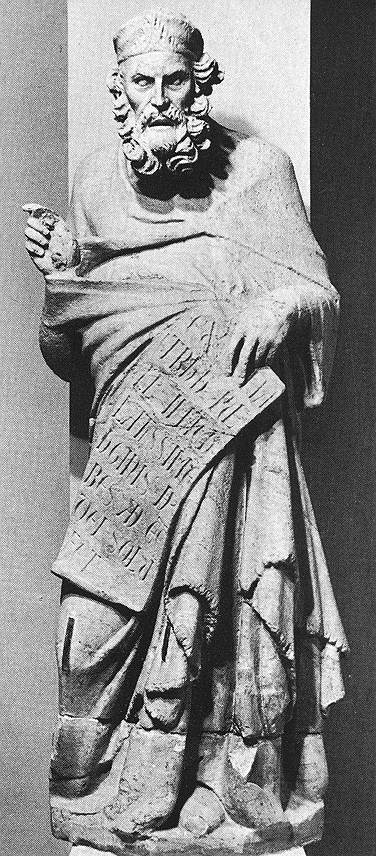
By 1284 Nicola was dead. Between the Perugia fountain and this date, Giovanni, alone or in company with his father, had carved the sculpture for the outside of the Pisa Baptistery (now in the Museo Nazionale). Here for the first time in Tuscany a scheme of monumental statuary was incorporated into architecture. Giovanni developed this much further in Siena, where from 1284 onwards he designed the façade of the cathedral and carried out much of the sculptural decoration (some of the figures have been transferred to the cathedral museum). It is the most richly decorated of all the great Italian Gothic cathedral façades, and the statuary has tremendous energy and inner life.
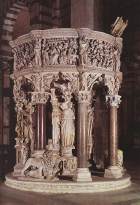
Giovanni's last two great works were pulpits for Sant'Andrea, Pistoia (1300-01), and Pisa Cathedral (1302-10). They are modelled on those of his father, but more elegant in style (showing French Gothic influence) and also more emotionally charged. The Pisa pulpit was damaged in a fire in 1599, then dismantled and reassembled, some parts being dispersed; several museums, including the Metropolitan Museum, New York, have fragments that are said to come from it. Giovanni also made a number of free-standing statues, the best known of which is the Virgin and Child on the altar of the Arena Chapel in Padua (c. 1305). Its grandeur and humanity suggests a close kinship with Giotto, amid whose celebrated frescos it stands.
37 SELECTED · 97 CATALOGUED
Giovanni Pisano's pulpit in Pisa Cathedral replaced an earlier pulpit by Guglielmo, now in Cagliari Cathedral. The pulpit was dismantled after a fire in 1595 and has suffered much damage from restorations, particularly those in 1926-29; its present position, between two of the nave columns instead of under the dome, makes it impossible to view it in the round.
The pulpit is the most sumptuous of the Pisano pulpits, it is of unprecedented size, dominated by the sense of continuous, multi-directional movement and frenetic energy. The complex iconographic programme was at least partly devised by the Dominicans of Santa Caterina, Pisa. The themes and sequences of the programme were prescribed by the patrons, but they were absorbed by Giovanni into his own harsh and dramatic vision, and he may have influenced the choice of some of the scenes.
21 SELECTED · 97 CATALOGUED
The central support of the pulpit is raised above eagles; the six outer columns rest on lions, plain figures, and the Atlas figure, symbol of original sin and the force of will. The Prophets and Sibyls in the spandrels and at the corners prefigure Christ, who is witnessed in the topmost order by the Evangelists and Apostles standing between the narrative reliefs of the Life of Christ.
The five narrative reliefs depict the (i) Story of the Birth of Jesus, (ii) Adoration of the Magi, (iii) Massacre of the Innocents, (iv) Crucifixion, and (v) Last Judgment.
12 SELECTED · 97 CATALOGUED
Giovanni Pisano's first major independent work was the façade of Siena Cathedral. He never completed this above the line of the gables over the doors. This lower part luckily preserves its original decoration, and here the first time one finds an Italian mason incorporating a major amount of large-scale figure sculpture into a façade design.
The façade turns decisively towards the Gothic in its decorative motifs and lavish use of large-scale figural sculpture. In contrast to Nicola, Giovanni's style is closer to the expressionistic Gothic of German sculpture than to the courtly style of France.
21 SELECTED · 97 CATALOGUED
Commentary is unavailable for this selection.
12 OF 97 RECORDS


@online{wga-pisano-giovanni,
  author       = {Krén, Emil and Marx, Daniel},
  title        = {PISANO, Giovanni},
  organization = {{Web Gallery of Art}},
  date         = {2026-09-09},
  url          = {https://beta.wga.hu/artists/pisano-giovanni-r1e2bda68beedd5},
  urldate      = {2026-09-09},
  langid       = {english}
}
ACCESSED 2026-09-09. REPLACE THE AUTHOR FIELD WITH THE COMMENTARY AUTHOR WHERE ONE IS NAMED.