03 — ARTWORK
Pulpit
- MEDIUM
- Marble, height 455 cm
- TYPE
- Religious
PALETTE
HOVER OR TAP A SWATCH FOR NAME, SHARE AND HEX. SAMPLED FROM THE IMAGE — INDICATIVE, NOT A PIGMENT ANALYSIS.
DEVELOPMENT BUILD — NOT FOR PUBLIC USE. CONTRIBUTE ON GITHUB.
03 — ARTWORK
PALETTE
HOVER OR TAP A SWATCH FOR NAME, SHARE AND HEX. SAMPLED FROM THE IMAGE — INDICATIVE, NOT A PIGMENT ANALYSIS.
COMMENTARY
UNDERLINED TERMS ARE DEFINED IN THE GLOSSARY.
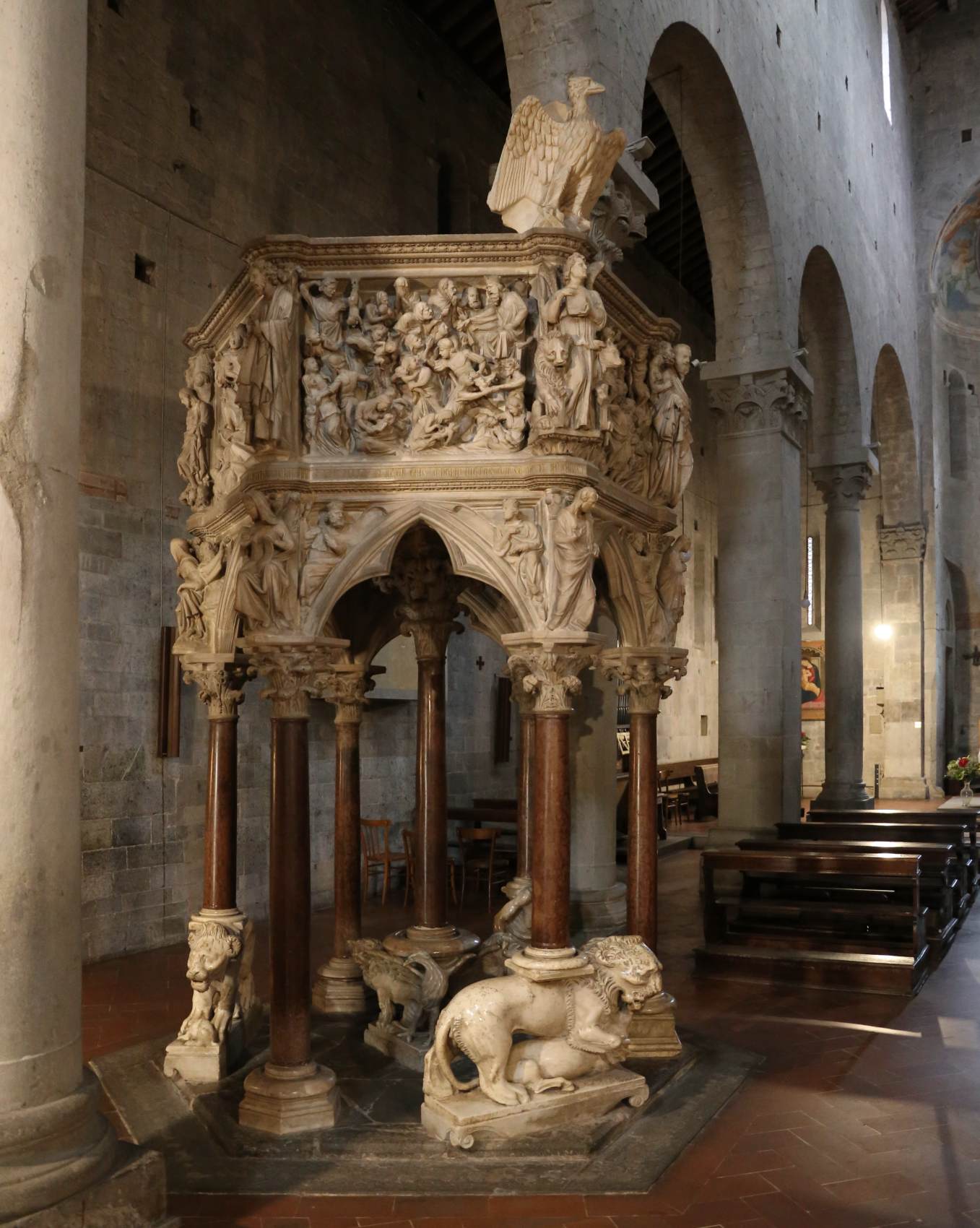
Giovanni Pisano's first pulpit, in Sant'Andrea, Pistoia, was begun c. 1298, partly executed in Pisa and finished in 1301, the date of the inscription, which describes the sculptor as the 'son of Nicola, and blessed with higher skill'. Many of the devices of <a onclick="return OpenOther('/html/p/pisano/nicola/1pisa/0pulpit1.html')" href="/html/p/pisano/nicola/1pisa/0pulpit1.html">Nicola's Pisa baptisteryHall or chapel situated close to, or connected with, a church, in which the sacrament of baptism is administered. The form of the baptistery originally evolved from small, circular Roman buildings that were designated for religious purposes (e.g., the Temple of Venus, Baalbek, Lebanon, AD 273, and the Mausoleum of Diocletian, Spalato [Split, Croatia], AD 300); but because baptism originally was performed on only three holidays, Easter, Pentecost, and Epiphany, enlargement of the older Roman buildings became necessary to accommodate the growing numbers of converts. Baptisteries were among the most symbolic of all Christian architectural forms; and the characteristic design that was developed by the 4th century AD can be seen today in what is probably the earliest extant example, the baptistery of the Lateran palace in Rome, built by Sixtus III, pope between 432 and 440. The baptistery was commonly octagonal in plan, a visual metaphor for the number eight, which symbolized in Christian numerology a new beginning. As eight follows the "complete" number, seven, so the beginning of the Christian life follows baptism. Customarily, a baptistery was roofed with a dome, the symbol of the heavenly realm toward which the Christian progresses after the first step of baptism. The baptismal font was usually octagonal, set beneath a domical ciborium, or canopy, and encircled by columns and an ambulatory--features that were first used in the baptistery by the Byzantines when they altered Roman structures. Baptisteries commonly adjoined the atrium, or forecourt, of the church and were often large and richly decorated, such as those at Pisa, Florence, Parma, and Nocera in Italy; el Kantara, Alg.; and Poitiers, France. After the 6th century they were gradually reduced to the status of small chapels inside churches. In the 10th century, when baptism by affusion (pouring liquid over the head) became standard practice in the church, baptisteries, or baptismal chapels, were often omitted entirely. In most modern churches the font alone serves for baptism; something of earlier symbolism survives, however, in its usual location near the church door - an allusion to entering the Christian life. pulpit</a> reappear (e.g. the hexagonal structure, trefoil arches, and iconographic sequences, although the Presentation is replaced by the Massacre of the Innocents, as in <a onclick="return OpenOther('/html/p/pisano/nicola/2siena/1pulpit1.html')" href="/html/p/pisano/nicola/2siena/1pulpit1.html">Nicola's Siena pulpit</a>), but the compositional conception is radically revised. There is greater unity of architecture and sculpture, with the vigorously projecting statues between the panels and the deeply undercut reliefs, each independent of its neighbour; the verticals are more accentuated, with slimmer supports and acutely pointed arches; and, most important, the visual stability of the pulpit is undermined by the suggestion that the columna vertical structural member having a circular cross-section and usually consisting of a base, a long shaft, and a capital. on the shoulders of Atlas is beginning to slip.
The central support of the pulpit is raised above eagles; the six outer columns rest on lions, plain figures, and the Atlas figure, symbol of original sinThe tendency to evil transmitted to mankind by Adam and Eve's transgression in eating of the Tree of Knowledge; inborn sin. and the force of will. The Prophets and SibylsIn antiquity, women who could prophesy. The many Sibylline prophecies were kept in Rome and consulted by the Senate. In Christian legend, Sibyls foretold the Birth, Passion and Resurrection of Christ, just as the male prophets of the Bible did. Originally, in the period of classical antiquity, there was only one Sibyl; the number gradually rose to ten. In early Christianity it was further raised to 12, in analogy to the 12 prophets of the Old Testament. in the spandrels and at the corners prefigure Christ, who is witnessed in the topmost order by the Evangelists and Apostles standing between the narrative reliefs of the Life of Christ. The modelling ranges from very low (and even incised) reliefA sculptural work in which all or part projects from the flat surface. There are three basic forms: low relief (bas-relief, basso rilievo), in which figures project less than half their depth from the background; medium relief (mezzo-rilievo), in which figures are seen half round; and high relief (alto rilievo), in which figures are almost detached from their background. to the fully rounded figures of the Sibyls, lions, and twisting Atlas. The varying treatment of the surfaces (in some places rough and unfinished, in others polished and translucent), the oblique poses of the figures, which increase in size and projection towards the top of the pulpit, the contrasts of crowded and bare areas, light and shade, the swirls and projections, all combine to create an extremely varied and intense visual language.
The composition of the first panelTerm in painting for a support of wood, metal, or other rigid substance, as distinct from canvas. Until the adoption of canvas in the 15th century nearly all the movable paintings of Europe were executed on wood, and even up to the beginning of the 17th century it is probable that as much painting was done on the one support as on the other. Painters who worked on a small scale often used copper panels (Elsheimer is a leading example), and in the colonial art of South America copper and tin and even lead and zinc were used. On a larger scale, slate has occasionally been used as a support, notably by Rubens for his altarpiece for Sta Maria in Vallicella (the Chiesa Nuova) in Rome; the picture he originally painted was said to reflect the light unpleasantly and slate was used for the replacement to produce a more matt finish. For wood panels the Italian masters of the Renaissance preferred white poplar, while oak was the most common wood used in northern Europe. Many other types were used, however; analysis of the contents of art galleries has yielded a long list, including beech, cedar, chestnut, fir, larch, linden, mahogany, olive, and walnut. In the 20th century cedar, teak, and dark walnut are favourites, and modern painters have also used plywood, fibre-board, and other synthetic materials as supports., showing the Annunciationthe term for the event described in the Gospel according to St. Luke, when the Angel Gabriel brings the Virgin Mary the news that she is to bear her son, Jesus Christ. The Annunciation was among the most widespread pictorial subjects of European art during the Middle Ages and the Renaissance., the Nativity, and the Annunciation to the Shepherds, is firmly welded together; that of the Adoration of the Magi undulates in sinuous but balanced curves to create effects of movement, while in the Massacre of the Innocents, a scene well suited to Giovanni's dramatic inspiration, the diagonal axes of the composition, emanating from Herod's forceful gesture in the top right-hand corner, are broken into triangular fragments, wedges, broken rhythms, and harsh angles. The formal elements thus reinforce the emotions of pain, horror, and refusal captured in the roughly carved faces, with their tragic expressions. In the CrucifixionAn important method of capital punishment, particularly among the Persians, Seleucids, Jews, Carthaginians, and Romans from about the 6th century BC to the 4th century AD. Constantine the Great, the first Christian emperor, abolished it in the Roman Empire in AD 337, out of veneration for Jesus Christ, the most famous victim of crucifixion. There were various methods of performing the execution. Usually, the condemned man, after being whipped, or "scourged," dragged the crossbeam of his cross to the place of punishment, where the upright shaft was already fixed in the ground. Stripped of his clothing either then or earlier at his scourging, he was bound fast with outstretched arms to the crossbeam or nailed firmly to it through the wrists. The crossbeam was then raised high against the upright shaft and made fast to it about 9 to 12 feet (approximately 3 metres) from the ground. Next, the feet were tightly bound or nailed to the upright shaft. A ledge inserted about halfway up the upright shaft gave some support to the body; evidence for a similar ledge for the feet is rare and late. Over the criminal's head was placed a notice stating his name and his crime. Death, apparently caused by exhaustion or by heart failure, could be hastened by shattering the legs (crurifragium) with an iron club, so that shock and asphyxiation soon ended his life., iconographically similar to Nicola's version, the figures surrounding the gaunt Christ, modelled with harsh angles between the contorted thieves, seem to be shaken by a strong wind. Finally, in the Last Judgement, the artist created a horrific vision of swarming, overwhelmed humanity.
@online{wga-r3af92141c8a91e,
  author       = {Krén, Emil and Marx, Daniel},
  title        = {Pulpit by PISANO, Giovanni},
  organization = {{Web Gallery of Art}},
  date         = {2026-09-08},
  url          = {https://beta.wga.hu/artists/pisano-giovanni-r1e2bda68beedd5/pulpit-r3af92141c8a91e},
  urldate      = {2026-09-08},
  langid       = {english}
}
ACCESSED 2026-09-08. REPLACE THE AUTHOR FIELD WITH THE COMMENTARY AUTHOR WHERE ONE IS NAMED.


