03 — ARTWORK
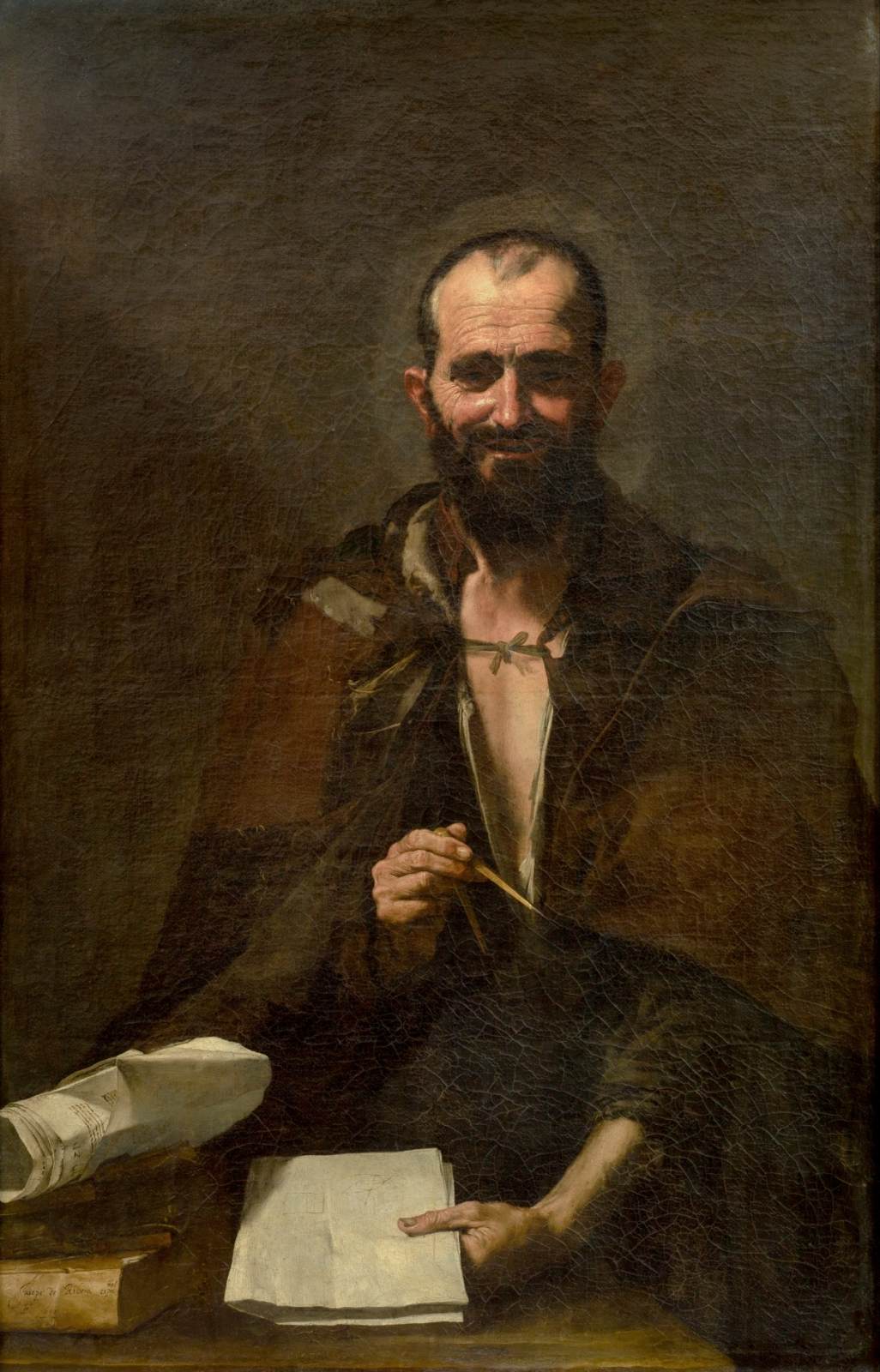
Democritus (Archimedes)
- MEDIUM
- Oil on canvas, 125 x 81 cm
- TYPE
- Mythological
PALETTE
HOVER OR TAP A SWATCH FOR NAME, SHARE AND HEX. SAMPLED FROM THE IMAGE — INDICATIVE, NOT A PIGMENT ANALYSIS.
DEVELOPMENT BUILD — NOT FOR PUBLIC USE. CONTRIBUTE ON GITHUB.
CURRENT LOCATION · Museo del Prado
03 — ARTWORK
PALETTE
HOVER OR TAP A SWATCH FOR NAME, SHARE AND HEX. SAMPLED FROM THE IMAGE — INDICATIVE, NOT A PIGMENT ANALYSIS.
COMMENTARY
UNDERLINED TERMS ARE DEFINED IN THE GLOSSARY.
The painting is one of the most celebrated of Jusepe de Ribera's so-called ragged philosophers. He appears to have been largely responsible for the invention of the subject in the mid 1610s, and it enjoyed great success in Italy over the course of the seventeenth century in the hands of artists such as Salvator Rosa and Luca Giordano.
The philosopher depicted here was traditionally identified as the ancient Sicilian mathematician Archimedes, since he holds a compass and a sheaf of papers displaying geometric designs, and is surrounded by books. However, in a learned article on the iconographyThe systematic study and identification of the subject-matter and symbolism of art works, as opposed to their style; the set of symbolic forms on which a given work is based. Originally, the study and identification of classical portraits. Renaissance art drew heavily on two iconographical traditions: Christianity, and ancient Greek and Roman art, thought and literature. of ancient philosophers published in 1962, Delphine Fitz Darby proposed that he should be identified as Democritus (c.460-c.370 BC) - the laughing philosopher who mocks the folly of human behaviour - on account of his grin. Democritus is usually paired with Heraclitus, the weeping philosopher who despairs at the absurdity of the world. It has to be said that Ribera rarely made a special effort to identify his philosophers.
The philosopher is shown here as a toothless old Spaniard. His weathered, wrinkled face has none of the marbled pallor of scholarship. In one thin hand, he holds a pile of papers and in the other a compass. His nails are dirty, his dress unkempt, and an old cloak is thrown carelessly over his undershirt, open to reveal his chest. He looks at us with a broad grin, and seems as close to the everyday life of Ribera's contemporaries as the artist's paintings of the saints. We find no monumental dignity here, only the dignity of a strong personality.
@online{wga-r1f77b44f4bf0f2,
  author       = {Krén, Emil and Marx, Daniel},
  title        = {Democritus (Archimedes) by RIBERA, Jusepe de},
  organization = {{Web Gallery of Art}},
  date         = {2026-09-13},
  url          = {https://beta.wga.hu/artists/ribera-jusepe-de-r2d1c510b430ea5/democritus-archimedes-r1f77b44f4bf0f2},
  urldate      = {2026-09-13},
  langid       = {english}
}
ACCESSED 2026-09-13. REPLACE THE AUTHOR FIELD WITH THE COMMENTARY AUTHOR WHERE ONE IS NAMED.


