02 — ARTIST
DÜRER, Albrecht
b. 1471 Nürnberg · d. 1528 Nürnberg
DEVELOPMENT BUILD — NOT FOR PUBLIC USE. CONTRIBUTE ON GITHUB.
02 — ARTIST
b. 1471 Nürnberg · d. 1528 Nürnberg
BIOGRAPHY
Painter and printmaker generally regarded as the greatest German Renaissance artist. His vast body of work includes altarpieces and religious works, numerous portraits and self-portraits, and copper engravings. His woodcuts, such as the Apocalypse series (1498), retain a more Gothic flavour than the rest of his work.
Education and early careerDürer was the second son of the goldsmith Albrecht Dürer the Elder, who had left Hungary to settle in Nuremberg in 1455, and of Barbara Holper, who had been born there. Dürer began his training as a draughtsman in the goldsmith's workshop of his father. His precocious skill is evidenced by a remarkable self-portrait done in 1484, when he was 13 years old (Albertina, Vienna), and by a Madonna with Musical Angels, done in 1485, which is already a finished work of art in the late Gothic style. In 1486, Dürer's father arranged for his apprenticeship to the painter and woodcut illustrator Michael Wohlgemut, whose portrait Dürer would paint in 1516. After three years in Wohlgemuth's workshop, he left for a period of travel. In 1490 Dürer completed his earliest known painting, a portrait of his father (Uffizi, Florence) that heralds the familiar characteristic style of the mature master.
Dürer's years as a journeyman probably took the young artist to the Netherlands, to Alsace, and to Basle, Switzerland, where he completed his first authenticated woodcut, a picture of St Jerome Curing the Lion (Kunstmuseum, Basle). During 1493 or 1494 Dürer was in Strasbourg for a short time, returning again to Basle to design several book illustrations. An early masterpiece from this period is a self-portrait with a thistle painted on parchment in 1493 (Louvre, Paris).
First journey to ItalyAt the end of May 1494, Dürer returned to Nuremberg, where he soon married Agnes Frey, the daughter of a merchant. In the autumn of 1494 Dürer seems to have undertaken his first journey to Italy, where he remained until the spring of 1495. A number of bold landscape watercolours dealing with subjects from the Alps of the southern Tirol were made on this journey and are among Dürer's most beautiful creations. Depicting segments of landscape scenery cleverly chosen for their compositional values, they are painted with broad strokes, in places roughly sketched in, with an amazing harmonization of detail. Dürer used predominantly unmixed, cool, sombre colours, which, despite his failure to contrast light and dark adequately, still suggest depth and atmosphere.
The trip to Italy had a strong effect on Dürer; direct and indirect echoes of Italian art are apparent in most of his drawings, paintings, and graphics of the following decade. While in Venice and perhaps also before he went to Italy, Dürer saw engravings by masters from central Italy. He was most influenced by the Florentine Antonio Pollaiuolo, with his sinuous, energetic line studies of the human body in motion, and by the Venetian Andrea Mantegna,. an artist greatly preoccupied with classical themes and with precise linear articulation of the human figure.
Dürer's secular, allegorical, and frequently self-enamoured paintings of this period are often either adaptations of Italian models or entirely independent creations that breathe the free spirit of the new age of the Renaissance. Dürer adapted the figure of Hercules from Pollaiuolo's The Rape of Deianira for a painting of Hercules and the Birds of Stymphalis (Germanisches Nationalmuseum, Nuremberg). A purely mythological painting in the Renaissance tradition, the Hercules is exceptional among Dürer's works. The centre panel from the Dresden Altarpiece, which Dürer painted in about 1498, is stylistically similar to the Hercules and betrays influences of Mantegna. In most of Dürer's free adaptations the additional influence of the more lyrical, older painter Giovanni Bellini, with whom Dürer had become acquainted in Venice, can be seen.
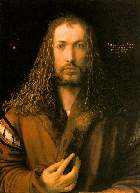
The most striking painting illustrating Dürer's growth toward the Renaissance spirit is a self-portrait, painted in 1498 (Prado, Madrid). Here Dürer sought to convey, in the representation of his own person, the aristocratic ideal of the Renaissance. He liked the way he looked as a handsome, fashionably attired young man, confronting life rather conceitedly. In place of the conventional, neutral, monochromatic background, he depicts an interior, with a window opening on the right. Through the window can be seen a tiny landscape of mountains and a distant sea, a detail that is distinctly reminiscent of contemporary Venetian and Florentine paintings. The focus on his own figure in the interior distinguishes his world from the vast perspective of the distant scene, another world to which the artist feels himself linked.
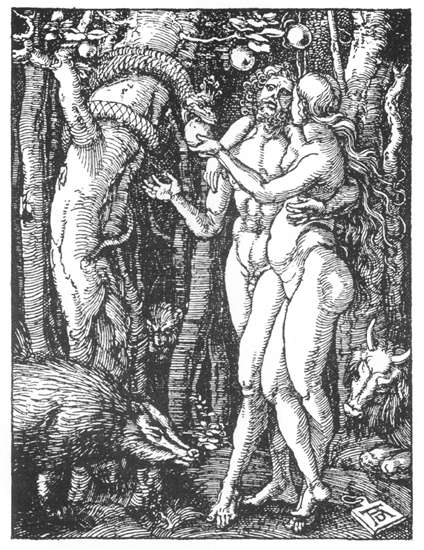
Italian influences were slower to take hold in Dürer's graphics than in his drawings and paintings. Strong late Gothic elements dominate the visionary woodcuts of his Apocalypse series (the Revelation of St John), published in 1498. The woodcuts in this series display emphatic expression, rich emotion, and crowded, frequently overcrowded, compositions. The same tradition influences the earliest woodcuts of Dürer's Large Passion series, also from about 1498. Nevertheless, the fact that Dürer was adopting a more modern conception, a conception inspired by classicism and humanism, is indicative of his basically Italian orientation. The woodcuts Samson and the Lion (c. 1498) and Hercules and many prints from the woodcut series The Life of the Virgin (c. 1500-10) have a distinct Italian flavour. Many of Dürer's copper engravings are in the same Italian mode. Some examples of them that may be cited are Fortune (c. 1502), The Four Witches (1497), The Sea Monster (c. 1498), Adam and Eve (1504), and The Large Horse (1505). Dürer's graphics eventually influenced the art of the Italian Renaissance that had originally inspired his own efforts. His painterly style, however, continued to vacillate between Gothic and Italian Renaissance until about 1500. Then his restless striving finally found definite direction. He seems clearly to be on firm ground in the penetrating half-length portraits of Oswolt Krel (Alte Pinakothek, Munich), in the portraits of three members of the aristocratic Tucher family of Nuremberg - all dated 1499 - and in the Portrait of a Young Man of 1500 (Alte Pinakothek). In 1500 Dürer painted another self-portrait (Alte Pinakothek, Munich) that is a flattering, Christlike portrayal.
During this period of consolidation in Dürer's style, the Italian elements of his art were strengthened by his contact with Jacopo de' Barbari, a minor Venetian painter and graphic artist who was seeking a geometric solution to the rendering of human proportions; it is perhaps due to his influence that Dürer began, around 1500, to grapple with the problem of human proportions in true Renaissance fashion. Initially, the most concentrated result of his efforts was the great engraving Adam and Eve (1504) in which he sought to bring the mystery of human beauty to an intellectually calculated ideal form. In all aspects Dürer's art was becoming strongly classical. One of his most significant classical endeavours is his painting Altar of the Three Kings (1504), which was executed with the help of pupils. Although the composition, with its five separate pictures, has an Italian character, Dürer's intellect and imagination went beyond direct dependence on Italian art. From this maturity of style comes the bold, natural, relaxed conception of the centre panel, The Adoration of the Magi (Uffizi), and the ingenious and unconventional realism of the side panels, once believed to belong to this altarpiece, one of which depicts the Drummer and Piper and the other Job and His Wife (Wallraf-Richartz-Museum, Cologne). However, the side panels belong to the Jabach altarpiece, the cenral panel of which is lost.
Second journey to ItalyIn the autumn of 1505, Dürer made a second journey to Italy, where he remained until the winter of 1507. Once again he spent most of his time in Venice. Of the Venetian artists, Dürer now most admired Giovanni Bellini, the leading master of Venetian early Renaissance painting, who, in his later works, completed the transition to the High Renaissance. Dürer's pictures of men and women from this Venetian period reflect the sweet, soft portrait types especially favoured by Bellini. One of Dürer's most impressive small paintings of this period, a compressed half-length composition of the Young Jesus with the Doctors of 1506, harks back to Bellini's free adaptation of Mantegna's Presentation in the Temple. Dürer's work is a virtuoso performance that shows mastery and close attention to detail. In the painting the inscription on the scrap of paper out of the book held by the old man in the foreground reads, "Opus quinque dierum" ("the work of five days"). Dürer thus must have executed this painstaking display of artistry, which required detailed drawings, in no more than five days. Of even greater artistic merit than this quickly executed work are the half-length portraits of young men and women painted between 1505 and 1507, which seem to be entirely in the style of Bellini. In these paintings there is a flexibility of the subject, combined with a warmth and liveliness of expression and a genuinely artistic technique, that Dürer otherwise rarely attained.
In 1506, in Venice, Dürer completed his great altarpiece The Feast of the Rose Garlands for the funeral chapel of the Germans in the church of St Bartholomew. Later that same year Dürer made a brief visit to Bologna before returning to Venice for a final three months. The extent to which Dürer considered Italy to be his artistic and personal home is revealed by the frequently quoted words found in his last letter from Venice (dated October 1506) to Willibald Pirckheimer, his long-time humanist friend, anticipating his imminent return to Germany: "O, how cold I will be away from the sun; here I am a gentleman, at home a parasite."
Development after the second Italian tripBy February 1507 at the latest, Dürer was back in Nuremberg, where two years later he acquired an impressive house (which still stands and is preserved as a museum). It is clear that the artistic impressions gained from his Italian trips continued to influence Dürer to employ classical principles in creating largely original compositions. Among the paintings belonging to the period after his second return from Italy are Martyrdom of the Ten Thousand (1508) and Adoration of the Trinity (1511), which are both crowd scenes. Drawings from this period recall Mantegna and betray Dürer's striving for classical perfection of form through sweeping lines of firmly modeled and simple drapery. Even greater simplicity and grandeur characterize the diptych of Adam and Eve (1507; Prado), in which the two figures stand calmly in relaxed classical poses against dark, almost bare, backgrounds.
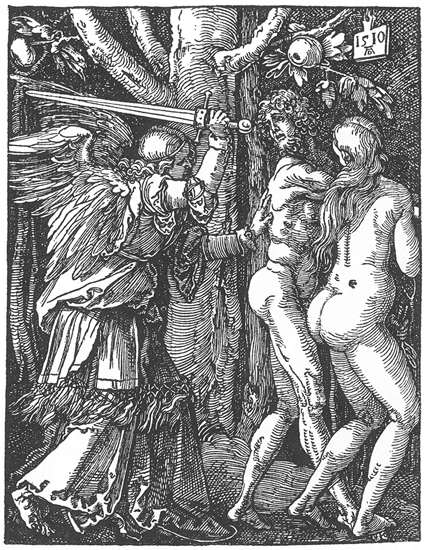
Between 1507 and 1513 Dürer completed a Passion series in copperplate engravings, and between 1509 and 1511 he produced the Small Passion in woodcuts. Both of these works are characterized by their tendency toward spaciousness and serenity. During 1513 and 1514 Dürer created the greatest of his copperplate engravings: the Knight, Death and Devil, St Jerome in His Study, and Melencolia I - all of approximately the same size. The extensive, complex, and often contradictory literature concerning these three engravings deals largely with their enigmatic, allusive, iconographic details. Although repeatedly contested, it probably must be accepted that the engravings were intended to be interpreted together. There is general agreement, however, that Dürer, in these three master engravings, wished to raise his artistic intensity to the highest level, which he succeeded in doing. Finished form and richness of conception and mood merge into a whole of classical perfection. To the same period belongs Dürer's most expressive portrait drawing - one of his mother.
Service to Maximilian IWhile in Nuremberg in 1512, the Holy Roman emperor Maximilian I enlisted Dürer into his service, and Dürer continued to work mainly for the emperor until 1519. He collaborated with several of the greatest German artists of the day on a set of marginal drawings for the emperor's prayer book. He also completed a number of etchings in iron (between 1515 and 1518) that demonstrate his mastery of the medium and his freedom of imagination. In contrast to these pleasing improvisations are the monumental woodcuts, overloaded with panegyrics, made for Maximilian. In these somewhat stupendous, ornate woodcuts, Dürer had to strain to adapt his creative imagination to his client's mentality, which was foreign to him.
Besides a number of formal show pieces - a painting entitled Lucretia (1518; Alte Pinakothek), and two portraits of the emperor (c. 1519) - during this decade Dürer produced a number of more informal paintings of considerably greater charm. He also traveled. In the fall of 1517 he stayed in Bamberg. In the summer of 1518 he went to Augsburg where he met Martin Luther, who had in the previous year circulated his Ninety-five Theses denouncing the sale of papal indulgences. Dürer later became a devoted follower of Luther. Dürer had achieved an international reputation as an artist by 1515, when he exchanged works with the illustrious High Renaissance painter Raphael.
Final journey to the NetherlandsIn July 1520 Dürer embarked with his wife on a journey through the Netherlands. In Aachen, at the October 23 coronation of the emperor Charles V, successor to Maximilian I (who had died in 1519), Dürer met and presented several etchings to the mystical and dramatic Matthias Grünewald, who stood second only to Dürer in contemporary German art. Dürer returned to Antwerp by way of Nijmegen and Cologne, remaining there until the summer of 1521. He had maintained close relations with the leaders of the Netherlands school of painting. In December 1520 Dürer visited Zeeland and in April 1521 traveled to Bruges and Ghent, where he saw the works of the 15th-century Flemish masters Jan and Hubert van Eyck, Rogier van der Weyden, and Hugo van der Goes, as well as the Michelangelo Madonna. Dürer's sketchbook of the Netherlands journey contains immensely detailed and realistic drawings. Some paintings that were created either during the journey or about the same time seem spiritually akin to the Netherlands school - for example, the St Anne with the Virgin and Child (Metropolitan Museum of Art, New York City), a half-length picture of St Jerome (1521; Museu Nacional de Arte Antiga, Lisbon), and the small portrait of Bernhard von Resten, previously Bernard van Orley (Gemäldegalerie, Dresden).
Final worksBy July, the travelers were back in Nuremberg, but Dürer's health had started to decline. He devoted his remaining years mostly to theoretical and scientific writings and illustrations, although several well-known character portraits and some important portrait engravings and woodcuts also date from this period. One of Dürer's greatest paintings, the so-called Four Holy Men (St John, St Peter, St Paul, and St Mark), was done in 1526. This work marks his final and certainly highest achievement as a painter. His delight in his own virtuosity no longer stifled the ideal of a spaciousness that is simple, yet deeply expressive.
Dürer died in 1528 and was buried in the churchyard of Johanniskirchhof in Nuremberg. That he was one of his country's most influential artists is manifest in the impressive number of pupils and imitators that he had. Even Dutch and Italian artists did not disdain to imitate Dürer's graphics occasionally. The extent to which Dürer was internationally celebrated is apparent in the literary testimony of the Florentine artist Giorgio Vasari (1511-74), in whose Lives of the Most Eminent Italian Architects, Painters and Sculptors, the importance of Albrecht Dürer, the "truly great painter and creator of the most beautiful copper engravings," is repeatedly stressed. Like most notable Italian artists, Dürer probably felt himself to be an "artist-prince," and his self-portraits seem incontestably to show a man sure of his own genius.
16 SELECTED · 487 CATALOGUED
Commentary is unavailable for this selection.
11 SELECTED · 487 CATALOGUED
Commentary is unavailable for this selection.
12 SELECTED · 487 CATALOGUED
Commentary is unavailable for this selection.
10 SELECTED · 487 CATALOGUED
Commentary is unavailable for this selection.
15 SELECTED · 487 CATALOGUED
Commentary is unavailable for this selection.
15 SELECTED · 487 CATALOGUED
Commentary is unavailable for this selection.
5 SELECTED · 487 CATALOGUED
Commentary is unavailable for this selection.
4 SELECTED · 487 CATALOGUED
The copper plates were too soft to permit repeated printing without a weakening of the finer lines. Therefore, after the interruption occasioned by his second sojourn beyond the Alps, Dürer began experimentation with drypoint (1512). The result did not please him as it pleases his present-day admirers, and after only three experiments, therefore, Dürer ceased to work in this medium. He continued to search for new ways to achieve his ends.
16 SELECTED · 487 CATALOGUED
Commentary is unavailable for this selection.
14 SELECTED · 487 CATALOGUED
Commentary is unavailable for this selection.
14 SELECTED · 487 CATALOGUED
Commentary is unavailable for this selection.
13 SELECTED · 487 CATALOGUED
Commentary is unavailable for this selection.
7 SELECTED · 487 CATALOGUED
During the 1510s Dürer was intensely occupied with a number of projects for the Emperor Maximilian I. These included the Triumphal Arch and illustrations for the Prayer Book and for other planned publications. This did not, however, prevent Dürer from experimenting concurrently with etchings on iron (1515/18). Again the result was apparent disappointment and abandonment, notwithstanding the effectiveness of some of the sheets. After only six experiments Dürer ceased to work in this medium.
12 SELECTED · 487 CATALOGUED
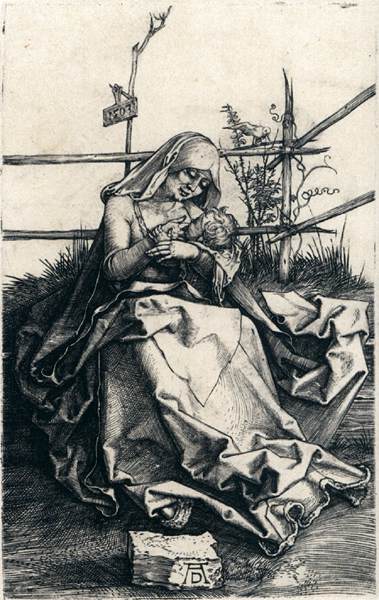
Dürer painted little in his later years, although he completed several fine portraits. In 1526 he painted the Nuremberg councilors Hieronymous Holzschuher and Jacob Muffel. In the same year Dürer also painted the portrait of the merchant Johannes Kleberger. In 1526 Dürer painted the last version of his favourite subject, the Madonna. The Virgin with the Pear depicts a deeply reflective Madonna offering the fruit to her chubby child. Dürer's final oil paintings, dating from 1526, were the pair of panels of The Four Holy Men. These works were presented to the city council as a gift from the artist.
14 SELECTED · 487 CATALOGUED
In November 1486, at the age of 15, Dürer was apprenticed to the painter Michael Wolgemut. Although Wolgemut would later be overshadowed by his talented pupil, he was then Nuremberg's leading artist. Wolgemut was a successful entrepreneur, handling a broad range of artistic work, such as painting altarpieces and portraits, designing stained glass and producing woodcut prints. Dürer remained as an apprentice with Wolgemut for three years, learning the basic skills.
In 1490, after his painter's apprenticeship in Michael Wolgemut's workshop ended, Dürer left on four years of travels as a journeyman to work for different masters, and immediately before departing painted the two portraits of his parents which were originally connected in the manner of a diptych and were separated after 1588. From his stay at Strasbourg two oil paintings survive, his first painted self-portrait and a devotional panel of Christ as the Man of Sorrows.
Returning to Nuremberg Dürer set up his workshop. His first paatron was Frederick the Wise, Elector of Saxony, who commissioned his portrait and two altarpieces for the church at his palace at Wittenberg. Of the first altarpiece, devoted to the Life of the Virgin, only the left half depicting the Seven Sorrows survives. The second altarpiece is the triptych of the Virgin between St Anthony the Hermit and St Sebastian.
In 1494 Dürer made his first Italian journey and spent the winter in Venice. Italian art was to have a strong influence on Dürer's own work, particularly in paintings such as the Virgin and Child before an Archway.
14 SELECTED · 487 CATALOGUED
In the years of 1518 and 1519, numerous painted and printed portraits were commissioned and created. Most official portraits of this period are a result of Dürer's involvement in the Imperial Diet in Augsburg in 1518 (e.g. the Portrait of Emperor Maximilian I).
In contrast to the public portraits commissioned by the upper classes and aristocracy, which were of a more official nature, Dürer used portraits of his close family for other purposes. His wife Agnes, for example, was his model for the painting of the Virgin and Child with St Anne.
In 1520, at the age of 49, Dürer set off on what was to be his last long journey, to the Netherlands. The country was also ruled by the Habsburgs and the area which Dürer visited was Flanders (present-day Belgium), where most of the artists were then based. He had met most of the great artists of the Netherlands and had seen much of their work. The most important painting he completed in Antwerp was a panel of St Jerome, modelled on a 93 year-old man he had sketched.
10 SELECTED · 487 CATALOGUED
The influence of Dürer's Italian trip can be seen in the two life-size panels of Adam and Eve, which he painted soon after his return in February 1507. Soon after Dürer's return to Nuremberg, Frederick the Wise commissioned yet another altarpiece, this one for the relic chamber of his church at Wittenberg. Completed in 1508, it is a gruesome depiction of The Martyrdom of the Ten Thousand.
Dürer was also working on an altarpiece for the Frankfurt cloth merchant Jacob Heller. While away in Venice his workshop had already begun painting the wings and Dürer himself did the central panel depicting the Coronation of the Virgin. The panel was destroyed in a fire at the Residenz in Munich in 1729. Only an early seventeenth-century copy of the central panel survives.
17 SELECTED · 487 CATALOGUED
A decade after his first visit to Venice, Dürer decided to return. In the autumn of 1505 he set off across the Alps. While in Venice, Dürer painted the portrait of Burkard von Speyer, as well as portraits of two women, one a gentle girl and the other a slightly older woman. Dürer also did a radiantly coloured picture known as The Madonna with the Siskin, named after the bird which is perched on the Christ child's shoulder.
By far the most important of Dürer's Venetian works, and the one which earned him his reputation for handling colour, is the altarpiece commissioned by the German merchants for the Church of San Bartolomeo. Known as The Altarpiece of the Rose Garlands, it depicts the Virgin distributing garlands to worshippers, led by the Pope and the Emperor.
After visits to Bologna and Florence Dürer may well have gone to Rome, where it is thought that he painted the panel of Christ among the Doctors. He must then have returned home via Venice.
16 SELECTED · 487 CATALOGUED
The sixteen subjects of the Engraved Passion are not as uniform in character as Dürer's two woodcut Passions because their development is spread over a longer period of time. The more Italianate, three-dimensional character of the Lamentation (No. 12) of 1507 can be pointed out, as compared with the subjects of 1512, which are conceived like two-dimensional paintings. Dürer seeks out difficult problems, extreme foreshortenings, details of heads and bodies, effects of costumes, all features which are omitted from the woodcut versions. He is working for a different audience, for the intelligentsia. These engravings have an air of artificiality but are nevertheless quite powerful.
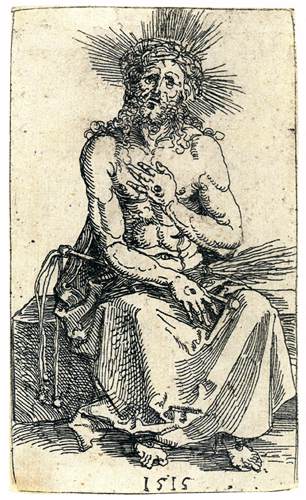
Without doubt, Dürer sold these sheets singly before the entire series was completed. The Man of Sorrows, the Bearing of the Cross and the Resurrection are particularly suitable for insertion into prayerbooks. For that reason these three subjects seem a little more dull in most complete sets. All sheets lack border lines. Dürer refers to the Engraved Passion on many occasions in the Diary of his trip to the Netherlands, 1520/21.
The series is presented here in the sequence of subjects, not in chronological order.
Suggested listening (streaming mp3, 8 minutes):
Johann Sebastian Bach: St. Matthew Passion BWV 244 (excerpts)
7 SELECTED · 487 CATALOGUED
The third altarpiece which Dürer completed after his return from Italy also contained a multitude of figures, a panel of The Adoration of the Holy Trinity. It was commissioned in 1508 by the wealthy Nuremberg metal-smelter Matthäus Landauer for the chapel of his Twelve-Brothers House, an almshouse set up to care for a dozen elderly artisans. Dürer also designed the intricately carved wooden frame for the painting, as well as stained-glass windows for the chapel, and the project took three years to complete.
14 SELECTED · 487 CATALOGUED
The moment when through Dürer's efforts the woodcut had reached its classic height, and when the publication of his great books had made a conquest for wood engraving of the kind of art that really appealed to the people, it fell a victim to the will of a potentate, Emperor Maximilian, who had no real feeling for this democratic art, but intended to make its technical perfection serve his own ambitious purposes. The woodcut had begun as a substitute for the miniature, as a miniature for the humble, and now after a century, the man who had brought this art to its height of power and freedom was destined to occupy the subordinate position of a copyist of miniatures. The woodcut had reached the steps of the throne, and the Emperor was tempted to entrust to this democratic form of art the portrayal of personal and dynastic matters, which hitherto had been the exclusive domain of the more aristocratic miniature. Dürer took part in the big imperial enterprises.
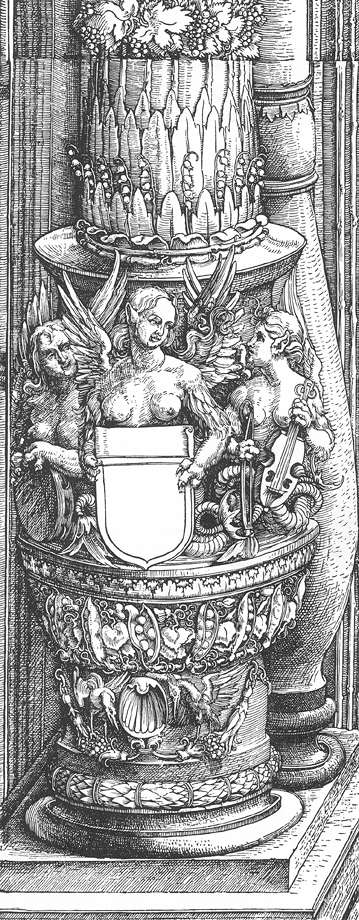
The first discussions regarding the Triumphal Arch (Gate of Honour) took place during the Emperor's visit to Nuremberg February 4-12, 1512. Johann Stabius the historiographer and court astronomer handed over to Dürer the learned programme and the architectural plan, which had been designed in paintings on vellum by the Innsbruck court painter and architect Kölderer, while to Dürer remained the rôle of making the drawings, so that on the steps of the Triumphal Arch beside the large escutcheon of Stabius and the middle sized one of Kölderer, his own could only appear in a small size. The date 1515 at the foot of the two corner towers refers to the date at which the work was finished, and in July of this year Dürer appeals to a friend to request the Emperor to pay him and points out that "I have served His Imperial Majesty for three years, suffered loss of fortune, and had I not exerted all my industry, the beautiful work would never have been finished in such a way".
Besides Dürer's hand we also recognise that of Springinklee, whose work was more closely allied to Dürer's and is easily distinguishable from the rougher work of Traut. The two corner towers were not carried out at Nuremberg, but at Ratisbon under the direction of Altdorfer.
The cutting was carried out by Hieronymus Andreae (or Resch), of Nuremberg, as is proved by his signature on the back of the blocks at Vienna, and the work lasted from 1515 to 1517.
Suggested listening (streaming mp3, 3 minutes):
Marc-Antoine Charpentier: Marche en Rondeau
15 SELECTED · 487 CATALOGUED
Commentary is unavailable for this selection.
10 SELECTED · 487 CATALOGUED
Commentary is unavailable for this selection.
11 SELECTED · 487 CATALOGUED
In 1511, Dürer returned to an increased study of printed graphics. Interactions between his paintings and graphics at this time as well as the experiences Dürer had gained on his second Italian journey are apparent in large-scale woodcuts such as the Holy Trinity and sheets from the Life of the Virgin. It is significant that Dürer turned to making series of woodcuts, such as the Small Passion and the Great Passion, the Life of the Virgin which Dürer published in 1511 in book form with poetry by the Benedictine monk Benedictus Chelidonius, and a new edition of the Apocalypse. In total, he produced nearly 90 woodcuts, some of which were very large in size, and these must have been very influential and ensured that the artist enjoyed a certain degree of financial independence from then on.
A development in form and graphic treatment discernible in the series The Life of the Virgin gives more aid in dating them than is to be found in the Apocalypse, a series more compact and less differentiated in style. The illustrations below follow the contents of the story, as told in the edition in book form of 1511.
Suggested listening (streaming mp3, 22 minutes):
Heinrich Schütz: Magnificat

DÜRER, Albrecht
VIEW WORK →
DÜRER, Albrecht
VIEW WORK →
DÜRER, Albrecht
VIEW WORK →
DÜRER, Albrecht
VIEW WORK →4 SELECTED · 487 CATALOGUED
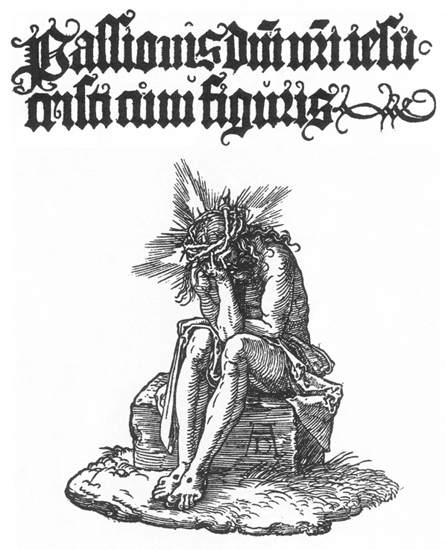
The Large Passion is named after the format of the series (39 x 28 cm). The whole series of twelve cuts did not appear till 1511 when Dürer published the cycle, together with a title page and a poem by the Benedictine theologian and friend of Willibald Pirckheimer, Benedictus Chelidonius (died 1521). The first seven woodcuts were executed between 1497 and 1500, then the series was completed by five cuts in 1510. The complete edition in book form appeared in 1511.
The pictures are distinguished by means of their strong emotions, naturalism and human treatment of the subject, thus distancing themselves from Late Gothic depictions of the Passion. Dürer considered the Passion to be the subject most worthy of representation in pictorial art, and he portrayed it five different times - a sixth version remained unfinished owing to his death. The subject, untrammelled by the strange pictorial apparatus of the Apocalypse, allows of a clearer expression of form and intention, and it is therefore easier to determine the dates.
17 SELECTED · 487 CATALOGUED
Apocalypse comes from Greek meaning an `unveiling'. The faith of the early Christians, living under persecution, was sustained by the expectation of Christ's imminent second coming. This found literary expression in the Revelation of John, written at the end of the first century A.D., an allegory foretelling the destruction of the wicked, the overthrow of Satan and the establishment of Christ's kingdom on earth, the `New Jerusalem'. It followed the tradition of Jewish apocalyptic writing going back to Daniel in the 2nd century B.C., in which was foreseen the deliverance of Israel from her oppressors by a sudden act of the divine will, and from which the author of the Revelation borrowed much of his imagery. Popular belief, for which there is no historical evidence, identified the writer whose name was John with John the Evangelist, and he is so represented in apocalyptic themes. Though the author is alluding to the contemporary condition of Christians under the Roman empire, succeeding ages placed their own interpretation on the allegory. Thus the figure of the Beast, or Antichrist, which stands for the pagan emperor (either Nero or Domitian both of whom caused the blood of many martyrs to flow), came to symbolize Islam to crusading Christians; to Catholics at the time of the Reformation it stood for Protestant heresy, while Lutherans made it a symbol of the corrupt papacy. The sequence of fantastic images with their often obscure symbolism - the author's `visions' - forms a loose cycle of themes that are found in religious art from the time of the Carolingian renaissance. They are seen in illuminated manuscripts, in the sculpture, stained glass and frescoes of churches, and in engravings and tapestries.
The greatest printmaking achievement of Dürer's early years was The Apocalypse, a set of 15 woodcuts on the revelations of St John. Telling the story of the end of the world and the coming of the Kingdom of God, this series of large prints displays great imagination and power. The famous series influenced the later treatment of the subject in northern Europe, especially France.
The Apocalypse was an immediate success. The terrifying, visions of the horrors of doomsday, and of the signs and portents preceding it, had never before been visualized with such force and power. There is little doubt that Dürer's imagination, and the interest of the public, fed on the general discontent with the institutions of the Church which was rife in Germany towards the end of the Middle Ages, and was finally to break out in Luther's Reformation. To Dürer and his public, the weird visions of the apocalyptic events had acquired something like topical interest, for there were many who expected these prophecies to come true within their lifetime.
Suggested listening (streaming mp3, 8 minutes):
Johann Sebastian Bach: St. Matthew Passion BWV 244 (excerpts)

DÜRER, Albrecht
VIEW WORK →
DÜRER, Albrecht
VIEW WORK →
DÜRER, Albrecht
VIEW WORK →
DÜRER, Albrecht
VIEW WORK →1 SELECTED · 487 CATALOGUED
Dürer's persistent striving with the art of painting had received new stimulus in Italy, and in his letters to Jacob Heller we hear of his hard struggle in his efforts to produce large pictures. However, the artist's imagination, pent up by his studies in painting, and also owing to the necessity of a more economic mode of life, was impelled to express itself in the woodcut. After the beginnings of the year 1509, in 1510 the production increases to five single cuts and six supplementary cuts to the Large Passion and to the Life of the Virgin, and reached its climax in the year 1511, in which appeared besides the edition of the three big works with new title pages and eight big separate woodcuts, the Small Passion with its thirty-seven woodcuts of which only three belong to the years 1509 and 1510.
2 SELECTED · 487 CATALOGUED
Commentary is unavailable for this selection.
16 SELECTED · 487 CATALOGUED
Commentary is unavailable for this selection.
10 SELECTED · 487 CATALOGUED
Commentary is unavailable for this selection.
11 SELECTED · 487 CATALOGUED
Commentary is unavailable for this selection.
12 SELECTED · 487 CATALOGUED
Commentary is unavailable for this selection.
16 SELECTED · 487 CATALOGUED
Dürer's other patrons for religious works were wealthy Nuremberg citizens. The Virgin and Child at a Window, with a delightful scene of Lot Fleeing with his Daughters from Sodom on the reverse, was painted in around 1498 for the Haller family, who were successful merchants.
Portraits were also in demand. In 1497 Dürer did a fine painting of a woman dressed in red, standing next to a window looking out over a landscape with distant hills (Staatliche Museen, Berlin). Two years later Dürer painted a striking portrait of the Lindau merchant Oswolt Krel, with wings depicting a pair of wild, hair-covered men holding family coats of arms. He also did a set of four portraits of the Tucher family, the brothers Niclas and Hans and their wives Elsbeth and Felicitas. For his own family, Dürer painted a second portrait of his elderly father in 1497 and another self-portrait the following year.
10 SELECTED · 487 CATALOGUED
Dürer's other patrons for religious works were wealthy Nuremberg citizens. The Paumgartner Altarpiece, begun in 1498, was a triptych of the Nativity. Dürer used the features of the donors, the Paumgartner brothers, when he painted the two saints on the wings. A panel of the Lamentation for Christ was commissioned by the goldsmith Albrecht Glim.
The culmination of Dürer's early portraits is the artist's final self-portrait of 1500, depicting the 28 year-old artist in a Christ-like pose.
8 SELECTED · 487 CATALOGUED
Frederick the Wise must have been pleased with Dürer. He later appears to have commissioned the artist to paint two further altarpieces, which were both completed in 1504. One of these was a triptych with wings depicting four saints on the inside and Job castigated by his wife on the outside. The central panel has long since disappeared and the theme of the triptych, now known as the Jabach Altarpiece because it once belonged to the Jabach family, remains unknown. The other commission from Frederick the Wise was for The Adoration of the Magi, which is among Dürer's masterpieces.
11 SELECTED · 487 CATALOGUED
Dürer continued to paint portraits, including a fine panel of his former master, Wolgemut. In his portraiture, he now focuses all attention on the head, shown in close-up and often tightly placed in the frame. Another of Dürer's portraits of 1516 depicts a clergyman. In the same year he painted the heads of two apostles, Philip and James, who have extremely anguished faces. These may well have been intended as part of a set of the 12 apostles.
In 1509 Dürer had been made a member of Nuremberg's Grand Council. This body, consisting of 200 leading citizens, had little real power, but the appointment was a sign of the artist's growing recognition. Four years later Dürer received his first commission from the city, to paint a pair of portraits of Charlemagne and Sigismund. These panels were to hang in the Treasure Chamber where the precious regalia of the Holy Roman Emperors were kept just before they went on their annual public display.
12 OF 487 RECORDS


@online{wga-drer-albrecht,
  author       = {Krén, Emil and Marx, Daniel},
  title        = {DÜRER, Albrecht},
  organization = {{Web Gallery of Art}},
  date         = {2026-09-08},
  url          = {https://beta.wga.hu/artists/drer-albrecht-r9b10ff91cb62c2},
  urldate      = {2026-09-08},
  langid       = {english}
}
ACCESSED 2026-09-08. REPLACE THE AUTHOR FIELD WITH THE COMMENTARY AUTHOR WHERE ONE IS NAMED.